Continuous Monitoring of Vendor AI Assets After Deployment
Vendors silently update AI models in production, leaving deployers exposed to undetected drift.
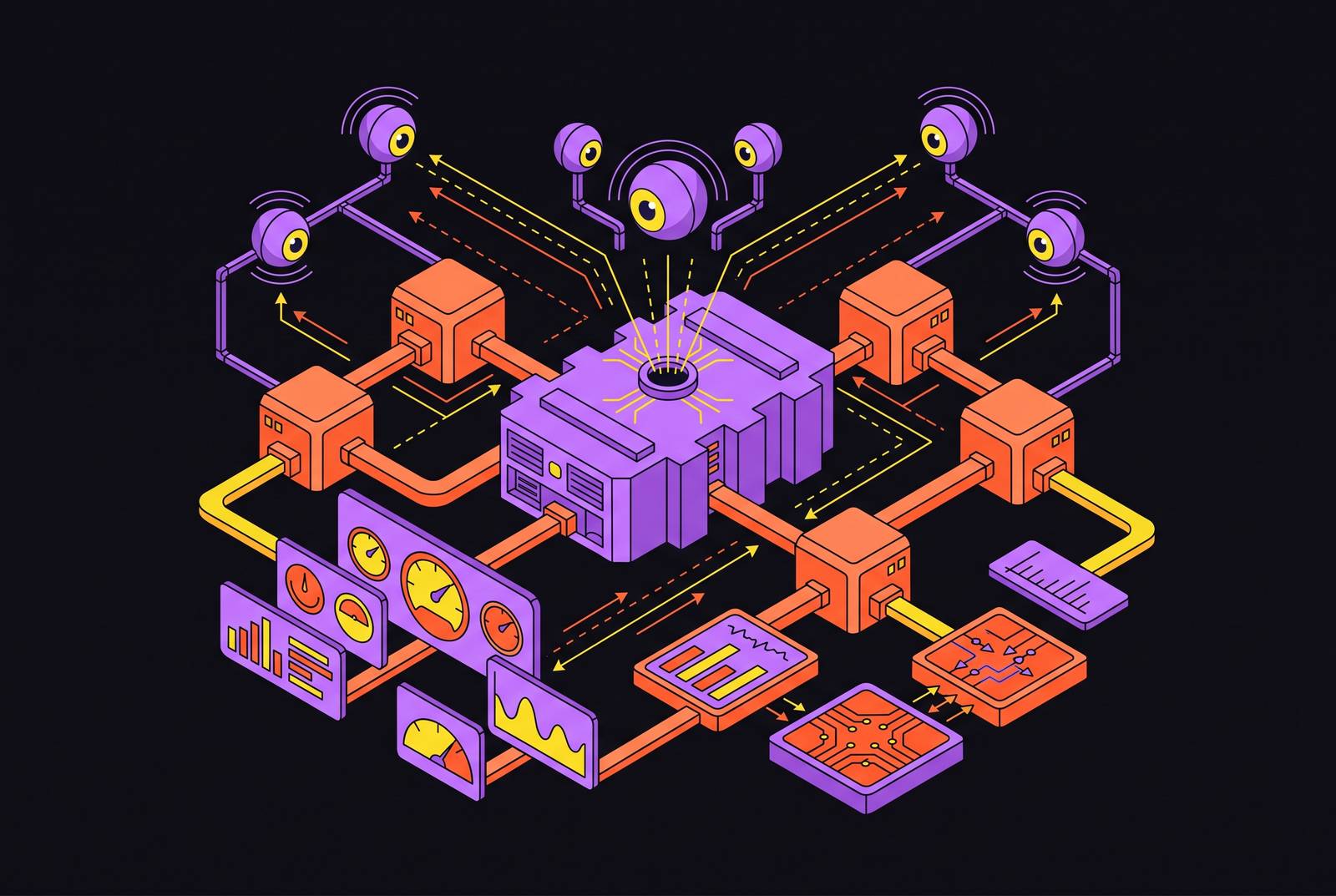
The real exposure begins at go-live, and it grows quietly from there through silent model updates, shadow AI, and attack vectors that target the model layer specifically, none of which a pre-deployment questionnaire can catch. For Fortune 500 legal and financial firms, the tools that matter now are the ones built to watch vendor AI assets continuously after deployment, not the ones that produce a clean report before it.
Why pre-deployment assessment is no longer enough
A signed vendor contract and a completed AI risk questionnaire can feel like a finish line. They are a starting gun. It only confirms that a model behaved acceptably in a test environment, on a given day, under conditions the vendor controlled. It says nothing about what the model does six months into production, after a retraining pass, a safety filter update, or a shift in the underlying data distribution.
The asymmetry at the center of this is structural. The vendor controls the inputs that shape the model: training data, fine-tuning passes, and safety guardrails. The deployer absorbs whatever behavior comes out the other end in production. A vendor can retrain a model, adjust its filters, or change its response patterns with a version update that carries no changelog.
Traditional software risk management assumes a new version is a discrete, auditable artifact: a release number, a diff, a changelog someone can review before rollout. AI systems break that assumption. Behavioral change in a deployed model is continuous, with no notification mechanism built into the relationship.
NIST AI 800-4 names this gap directly. Pre-deployment evaluations happen in controlled testing environments, so they cannot account for real-world dynamics, and because AI outputs are non-deterministic, the same input can produce a range of outcomes no test environment fully replicates. Most AI failures do not happen at launch. They accumulate quietly in production. Point-in-time governance is structurally blind to the failure mode that actually dominates.
Regulators do not care who trained the model. Liability sits with the deployer whether the system was built in-house or bought from a vendor, and a strong indemnification clause in the contract does not change who answers for a compliance failure after the fact.
How vendor AI risk silently expands after go-live
Once a system goes live, vendor AI risk compounds through at least three channels, and each one is nearly invisible to a standard vendor review cycle: silent model updates and behavioral drift, shadow AI buried inside tools already approved for use, and attack vectors built specifically to exploit the model layer.
Start with drift. A vendor can update a model silently, and the standard master service agreement gives you no contractual right to even learn it happened. A model that performed well and passed compliance checks at deployment can show statistically significant behavioral drift months later, purely from a shift in the data it's processing, and there is no standard service-level agreement that obligates the vendor to tell a customer when that happens. Vendors running continuous learning pipelines, federated training, or periodic fine-tuning can change a model's behavior with no versioned release attached to it. A migration to a new base model, a new retrieval pipeline, or a newly fine-tuned dataset can roll out without an announcement.
Shadow AI compounds the problem from a different angle. Microsoft shipped Copilot into Microsoft 365. Salesforce shipped Einstein into its CRM. Zoom, ServiceNow, Slack, and Atlassian all added AI features into products that were already under contract, often without separate notice to the customer. The vendor went through review. The AI capability added to that vendor afterward did not. That creates a fourth-party dependency: the vendor's AI may run on a foundation-model provider the enterprise never assessed and has no direct contractual relationship with. A vendor's entire risk profile can shift between one annual review and the next, because AI capabilities inside these platforms ship continuously, not on the vendor's contract renewal schedule.
The sharpest edge of this is active exploitation. CVE-2025-32711, known as EchoLeak, was a zero-click prompt injection against Microsoft 365 Copilot that allowed silent data exfiltration from SharePoint, OneDrive, and Teams through malicious prompts embedded inside a crafted email, with no user interaction required to trigger it. In September 2025, Noma Labs demonstrated an indirect prompt injection against Salesforce Agentforce: it hid inside a Web-to-Lead form's description field and chained with a content-security-policy bypass through an expired allowlisted domain that had been re-registered for about $5. Salesforce closed the hole through Trusted URL enforcement on September 8, 2025. Both incidents fall under what OWASP classifies as LLM01:2025, indirect prompt injection, where attacker-controlled instructions arrive through emails, documents, web pages, or retrieved records that the model treats as legitimate input because nothing in its pipeline flags the source as hostile.
Why the compliance exposure is now a timed problem
The gap between when unauthorized AI activity happens and when an enterprise detects it now runs longer than the window regulators give companies to report it once it's found. That turns a monitoring blind spot into a compliance violation with a clock attached to it.
A vendor indemnification clause in the contract does not move that obligation off the deployer's books.
CB Financial Services offers the clearest illustration of how fast this clock now runs. The company determined materiality on May 7, 2026, and filed what appears to be the first SEC Form 8-K publicly submitted on May 11, 2026, triggered by unauthorized employee AI use. That detail matters: the trigger wasn't a breach in the traditional sense. It was unauthorized use of an AI tool involving sensitive data, so data sensitivity alone may be enough to force a materiality disclosure, whether or not any system was actually disrupted.
Other frameworks are converging on the same demand for continuous visibility. SOC 2's CC7 criteria, ISO 27001's A.5.22 on supplier monitoring, and DORA's Article 28 all push in the same direction: ongoing oversight of vendor systems, not an annual snapshot. Putting those together with the EU AI Act and the CB Financial Services filing reveals an unmistakable pattern. Detection speed is now a compliance requirement in its own right, not just good security hygiene.
What a continuous post-deployment monitoring program must cover
A defensible monitoring program is a set of running capabilities, mapped directly to the specific ways vendor AI systems fail once they're in production.
NIST AI 800-4, published March 2026, lays out six categories that need to run continuously: functionality, operational, human factors, security, compliance, and large-scale impacts monitoring. These aren't sequential stages to move through one at a time. They run in parallel, because a system can be functionally stable while it quietly drifts on fairness, or operationally sound while it faces an attack vector nobody had mapped before. Building toward that kind of coverage works best moving from the simplest capability to the most structurally demanding one.
The starting point, and the easiest to stand up, is behavioral regression testing. Define a set of test inputs that probe the specific behaviors the organization actually depends on, then run them against the vendor's API on a fixed schedule. Material drift in the outputs is the signal to open a vendor inquiry, and potentially a full re-assessment. Automated monitoring built this way catches drift, bias, and security violations before they turn into reportable incidents, so it shortens the compliance exposure window discussed above. Without this in place, the failure mode is familiar: a provider updates the model, carefully tuned prompts stop behaving the way they did in testing, and support tickets become the de facto alerting system. Users find every regression before the internal team does.
The next layer up is supply chain visibility, built through an AI Bill of Materials. A functional AIBOM has to answer four questions on a continuous basis, not quarterly: what models are running, where did they come from, what can they reach, and who is allowed to change them. An AIBOM is the correct technical baseline for AI vendor supply chain assurance, and it differs from a traditional software bill of materials because it tracks model lineage and data access, not just code dependencies. The EU AI Act is pushing AIBOM from an optional security artifact toward an enforceable procurement requirement, so the contracts you sign today should already build toward that standard, not treat it as a future nice-to-have.
Above the supply chain layer sits the tooling that turns raw signals into something a governance team can act on: observability and runtime monitoring platforms. Several vendors have built into this space with different areas of strength. Arthur AI focuses on real-time policy enforcement, agent behavior tracking, and structured guardrails for multi-agent workflows, and it recently positioned itself around what it calls the Agentic Development Lifecycle. Fiddler AI concentrates on observability and explainability for regulated industries, but it carries a known limitation: reduced visibility into black-box model internals, since feature attribution methods it relies on do not provide true causal explanations for a model's behavior, which matters because those are the precise APIs most enterprises are actually purchasing. ServiceNow repositioned its AI Control Tower at Knowledge 2026 around discovering, governing, observing, and securing every AI agent and workflow across an enterprise, with its Traceloop acquisition providing the runtime observability layer underneath that positioning. Holistic AI launched Guardian Agents in 2026, split into Sentinel Agents for continuous observation and Operative Agents for real-time intervention when something goes wrong. Promptarmor fits into this same layer with a different starting point: it combines vendor risk assessment with real-time AI threat detection across the full vendor ecosystem, aiming to surface emerging threats before they breach compliance or business continuity, which addresses a gap between traditional third-party risk management and information security tooling that generic observability platforms don't close on their own. Each of these tools plays a distinct role. Each one answers a different piece of the six-category NIST framework, and a mature program will likely draw on more than one.
Data quality monitoring at the input level supports all of this. If the data feeding a high-risk AI system shifts in distribution or quietly degrades, that shift is itself a compliance signal, not just a performance concern, and it needs to feed into the same alerting pipeline as behavioral drift.
This is where the distinction between operational alerting and governance becomes concrete. A drift alert that lands in a Slack channel is an operational signal. But when a drift alert automatically opens a formal control re-assessment, that is a governance action. That distinction decides whether a monitoring program produces real accountability or just generates noise nobody acts on. Firms that get this right, especially in legal and financial services, build the regulatory documentation trail directly out of the monitoring data itself, rather than reconstructing it after an incident when an examiner comes asking.
Where the monitoring field itself acknowledges it is still underdeveloped
Even the organizations building these standards are candid about how early this discipline still is. METR's Frontier Risk Report, covering the assessment window from February 16 to March 16, 2026, ran a pilot exercise with participation from Anthropic, Google, Meta, and OpenAI specifically to assess misalignment risks from AI agents operating inside frontier AI developers themselves. That a pilot of this kind was still necessary in 2026, among the companies building the most capable models in the world, says something about how unsettled post-deployment risk assessment remains even at the frontier.
Procurement practice lags in a parallel way. Contractual language requiring vendors to deliver and maintain an AIBOM largely did not exist in 2024 templates, and teams that tried to write AIBOM requirements into contracts that year ran into a basic problem: there was no standard format to specify. The October 2024 OMB M-24-18 memo brought some movement, with initial AI vendor documentation and transparency requirements, but you still have to build the broader contractual infrastructure for demanding supply chain visibility from AI vendors in real time, because you cannot simply pull it off a shelf.
Enterprises that treat monitoring as a mature, solved category are working from an assumption the field's own builders don't share. The ones that treat it as a discipline still being built, and invest accordingly, are the ones positioned to meet the compliance timelines regulators are already enforcing.
Sources
- Challenges to the monitoring of deployed AI systems
- Frontier Risk Report (February to March 2026) - METR
- AI Model Registries: A Foundational Tool for AI Governance
- TRENDS Research & Advisory - The Post-Deployment Monitoring of Artificial Intelligence: Emerging Challenges in Oversight, Evaluation, and Accountability