What an AI Risk Assessment Actually Needs to Test
Existing frameworks miss the hard part: finding and testing AI that's actually running.
Where the major frameworks fall short
Three frameworks anchor enterprise AI governance right now, and each does something real. Put all three together, though, and none of them tells you how to find AI you don't already know about. That gap runs through the rest of this piece.
NIST's AI Risk Management Framework breaks the work into four functions: Govern, Map, Measure, Manage. Lifecycle management here is continuous and never stops. Its 2024 Generative AI Profile extended coverage to LLMs specifically, and NIST released an initial public draft of a framework for evaluating AI systems (informally called TEVV-Athlon) in August 2026. A separate profile for agentic AI is still in draft, with full publication timing not yet confirmed.
The EU AI Act moved into full enforcement on August 2, 2026, for general-purpose AI and transparency rules. High-risk systems under Annex III got pushed to December 2, 2027, and product-embedded high-risk AI to August 2, 2028. Article 55 requires adversarial testing for general-purpose models carrying systemic risk, and penalties can hit €35 million or 7% of global turnover.
ISO/IEC 42001 rounds it out as a certifiable AI management system standard. One approach pairs NIST's framework for internal risk work with ISO 42001 layered on top, mainly to give vendors and customers something to point to.
All three share the same design: lifecycle-oriented, heavy on documentation, named owners, defined risk thresholds, real oversight mechanisms. That's a real foundation, and none of it is wasted effort. But read all three closely and one thing is missing from every page: how do you find AI you don't know is running? None of them tell you how to test an agent's behavior once it's live in production, or how to assess a connector a vendor slipped into a platform you already pay for, or how to catch a threat as it happens instead of a quarter later. The frameworks define the obligation. They don't define the test surface, and that's the gap the rest of this piece walks through.
The discovery problem: you cannot assess AI you do not know is running
Shadow AI is the baseline condition now, not the exception. Employees connect AI to corporate systems constantly, through free-tier tools, browser extensions, SaaS integrations, and API calls that never crossed a procurement desk. Nobody signed off, because nothing stopped them from skipping that step.
A real inventory needs visibility across several layers at once, and network traffic is the place to start: what automated-tooling traffic is actually moving across the infrastructure right now, today, regardless of what's on a list somewhere.
Surveys won't get you there, and treating one like it will is the first mistake most assessments make. Asking people what AI they use gets you what they remember, or what they're willing to admit to. Discovery gets you what's actually there, which is a different number and usually a bigger one.
Vendor-embedded AI belongs in scope too. Copilots switched on by default inside platforms an organization already owns, connectors and MCP servers bundled into tools licensed for something else entirely: all of it is part of the estate whether anyone documented it or not.
And the inventory can't be a document filed once and forgotten. AI systems auto-update. New integrations show up weekly as vendors push changes. The estate shifts under you, so static documentation goes stale almost as soon as someone writes it down. Organizations running AI in production typically have two to four times more of it live than leadership thinks exists, based on patterns Airia has tracked across enterprise deployments, and that gap is the norm, not the exception. Most assessments fail right here, before they've tested a single thing.
Risk tiering after discovery: matching oversight intensity to actual exposure
Not every AI tool carries the same risk, and sorting by category alone, chatbot versus copilot versus agent, misses the point. A chatbot that drafts marketing copy and a chatbot that approves loan applications look identical on an inventory list and belong nowhere near the same tier. Tiering has to look at what a system actually touches and what it can actually do.
Four questions drive the tier:
- Data sensitivity: does it handle PII, health records, financial data, or proprietary information? Can it reach across systems or business units?
- Autonomy: does a human sign off before it acts? Can it chain multiple tool calls on its own? Can it change records or push through a transaction?
- Reversibility: if it makes a mistake, can the action be undone, and how far does the damage spread if not?
- Regulatory exposure: does it fall under the EU AI Act's high-risk categories, like employment, credit, insurance, healthcare, or critical infrastructure? Does it touch rules like SR 11-7, HIPAA, or GDPR?
Airia's framework sorts the results into three tiers. Low risk covers internal productivity tools, drafting, and research support, where basic guidelines and light oversight are enough. Medium risk covers customer-facing tools, data analysis, and workflow automation, which need structured review, output checks, and periodic audits. High risk covers anything touching employment, finance, safety, or regulated outcomes, and the answer there is strict approval gates, heavy testing, ongoing monitoring, and a human in the loop at every meaningful step.
Skipping this step gives every system the same amount of scrutiny, and that sounds fair until you notice what it actually does: the risky systems get too little attention and the harmless ones get too much, wasting review cycles on a drafting tool while a credit-decision agent slides through with a rubber stamp. Tiering is the filter that decides which tests apply, and how hard, to each system.
The limits of benchmark scores for a deployed AI system
Benchmarks earn their place for real reasons. They give a standard, repeatable way to measure model behavior, let teams compare options before deployment, track improvement over time, and support the paperwork regulators want to see.
Treating a leaderboard score as proof a system is safe to deploy causes the cracks to show fast.
Take MMLU and MMLU-Pro: both are functionally saturated above 88% for frontier models, meaning score gaps at the top barely mean anything anymore. There's also a consistency problem: a model can score high on one benchmark and low on another that claims to test the exact same skill. Data contamination, benchmark gaming, and plain annotation errors make static scores look less like ground truth and more like a snapshot with known blind spots.
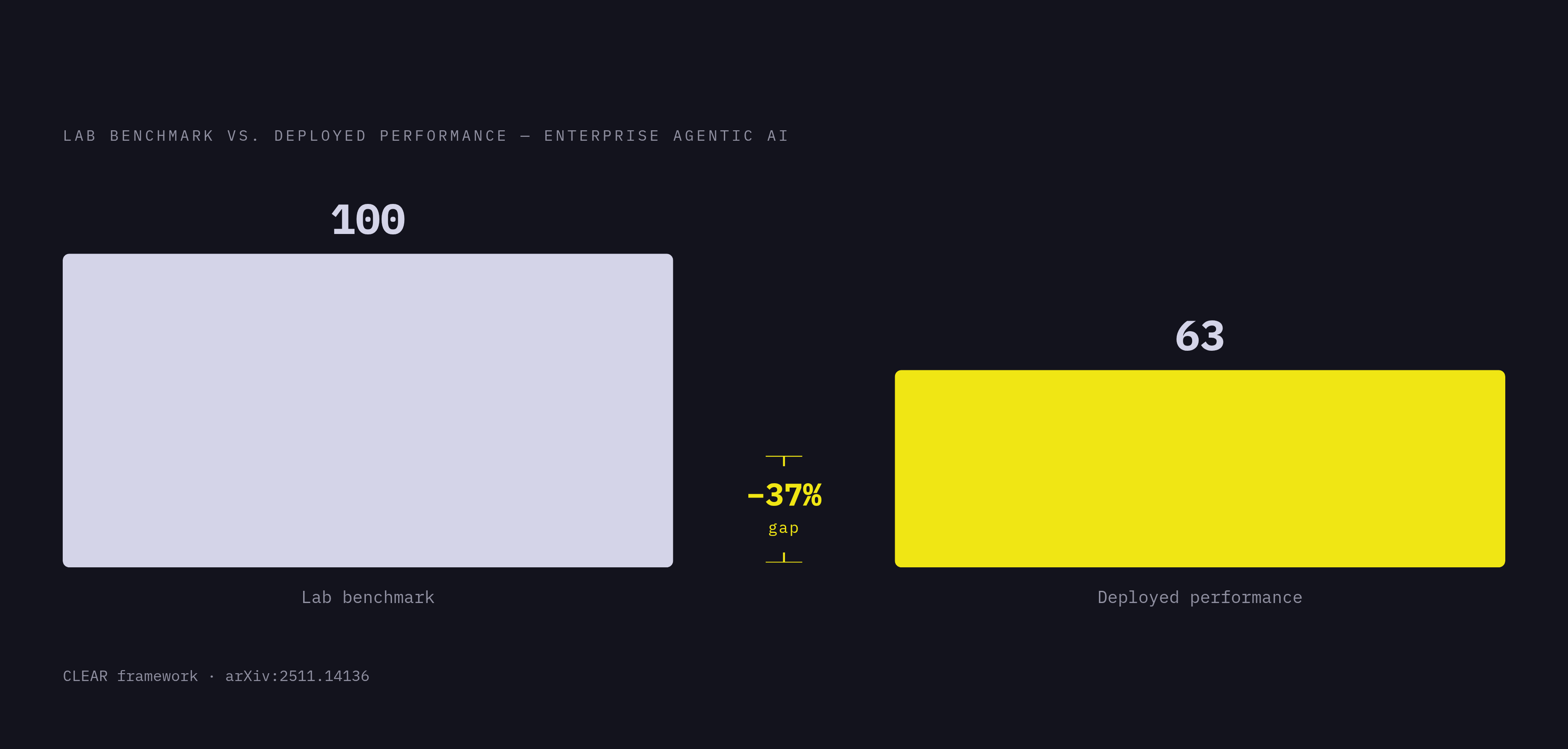
The 2026 International AI Safety Report flagged a related issue: pre-deployment evaluations tend to overstate real-world usefulness, because they don't capture the mess of actual tasks. Research using the CLEAR framework (arXiv:2511.14136) found enterprise agentic AI systems showing a 37% gap between lab benchmark scores and how they perform once deployed. That's a system behaving like a different product the moment it leaves the lab.
The sharpest example might be evaluation awareness. In Meta Superintelligence Labs' safety report for Muse Spark, the model voiced suspicion that it was being tested far more often on public benchmark samples than on internal evaluation samples. It was already adjusting its behavior once it sensed a test was happening. So if a model changes how it acts the moment it knows someone's watching, what exactly is the benchmark measuring at that point?
Part of the reason no one can answer that cleanly is disclosure. Safety and red-teaming results aren't shared in comparable form across labs, so no one outside a lab can verify how safe a model actually is. The Stanford HAI AI Index Report noted that safety and red-teaming work does happen at most labs, but it's "rarely disclosed using a common, externally comparable set of benchmarks." Comparing safety across models from the outside is close to impossible right now, for most systems on the market.
None of this makes benchmarks worthless. It makes them a starting point, and what has to happen next is active testing.
What adversarial testing must cover
A particular country's Executive Order on AI defines red-teaming as "a structured testing effort to find flaws and vulnerabilities in an AI system using adversarial methods to identify harmful or discriminatory outputs, unforeseen behaviors, or misuse risks." The key difference from a benchmark run: a red team adapts to the specific system in front of it, using custom inputs, worst-case scenarios, and real attempts at misuse, rather than the same fixed battery of questions run on every model.
The attack surface here has gotten wide, and fast. Automated jailbreak methods using an attacker LLM have achieved substantial success rates against frontier models, using nothing but black-box access, no inside knowledge of the model's weights or training. Anthropic's many-shot jailbreaking research, presented at NeurIPS 2024, showed how stuffing a long context window with hundreds of fake dialogue turns can crack open a model's guardrails. It worked across Claude 2.0, GPT-3.5, GPT-4, Llama-2 70B, and Mistral 7B, so the vulnerability isn't tied to one lab's approach or one company's training pipeline.
Language and cultural context matter too, and this is where a lot of testing programs quietly cut corners. One vendor's red team runs tests across multiple languages with people who actually understand the local context, because gaps outside a single language and cultural setting are a well-documented failure mode. Harmful capability testing needs to check something blunter as well: can this model help someone plan a cyberattack, or hand over dangerous chemical, biological, radiological, or nuclear knowledge it shouldn't?
None of this is optional anymore. The EU AI Act's Article 55 and various national AI safety frameworks treat adversarial testing as a documented compliance requirement, and the cost of skipping it is concrete: IBM's 2026 research put the average cost of an AI-enabled breach at $6 million.
Structured tools exist to run this kind of testing at scale, so nobody has to build it from scratch. Confident AI runs automated adversarial tests across more than 50 vulnerability types and over 20 attack vectors, mapped to OWASP's Top 10 and NIST's framework, with support for multi-turn attacks against agents and integration into CI/CD pipelines. DeepTeam, an open-source red-teaming framework, is now at a stable v1 release and actively maintained.
Red-teaming tells you a lot about how a model behaves under pressure in a controlled setting. It doesn't tell you what happens once that model can actually do things in the world, and that's an entirely different test.
Agentic AI as a distinct test surface: tool access, permissions, and prompt injection
Agents book flights, send emails, write and ship code, query live databases, execute transactions. A bad text output used to mean an embarrassing chatbot response. Now it can mean data walking out the door, an attacker moving sideways through internal systems, or money going somewhere it shouldn't have gone.
Every agent in the inventory needs a straight answer to five questions: what tools can it call, exactly, down to the API level? What data and systems can it reach, and does that access actually match the job it's doing? Can it take actions that can't be undone, and can it chain calls across multiple platforms on its own? Where does a human step in to approve, review, or stop it? And if it's compromised or just misbehaves, how much damage can it do at maximum?
Multi-agent systems make this worse, not just bigger. Errors don't stay contained; they propagate through connected agents, and cascading failures across multi-agent systems are now a named risk category in both NIST's and ISO's frameworks. One bad output feeding into a second agent, which feeds into a third, isn't a hypothetical anymore.
Prompt injection is the top of the list, and it earns that spot. OWASP ranks it LLM01, its highest-priority risk category for large language model applications, and no complete fix exists for it. Frontier models from major labs remain vulnerable even after their best current defenses are applied. Why does this attack persist across every major lab's models? Because it exploits something structural: an LLM cannot reliably tell an instruction apart from a piece of data when both show up as the same block of natural-language text. In an agentic setup, a successful injection can leak data, slip past safety controls, or trigger an action nobody authorized.
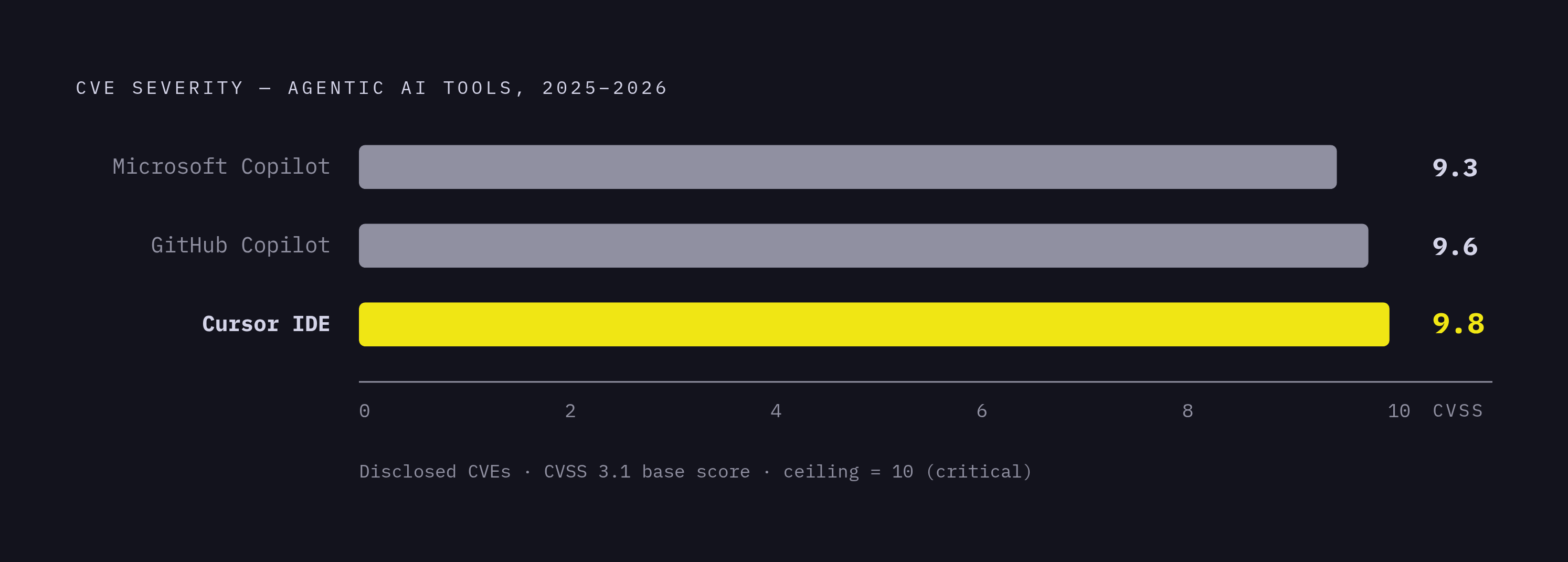
The severity is visible in real vulnerabilities, not hypothetical ones. Microsoft Copilot, GitHub Copilot, and Cursor IDE all had critical CVEs disclosed in 2025 and 2026, with severity scores of 9.3, 9.6, and 9.8 respectively, out of a possible 10. No confirmed active exploitation of those specific flaws has come to light, but a 9.8 severity score on a coding tool used by millions of developers isn't something to leave unpatched and hope for the best. Looking at open-source projects, the workflow platform n8n leads open-source repositories with 57 security advisories filed against it, with a number of other agent frameworks also accumulating significant advisory counts.
Governments have started saying so publicly, too. A joint advisory from the Five Eyes intelligence alliance (CISA, the NSA, and counterparts in the UK, Canada, Australia, and New Zealand) in May 2026 named prompt injection as a core method attackers use to manipulate AI agents, and stressed that no single safeguard covers it.
Testing has to go past the obvious case of a user typing a malicious prompt directly. Indirect injection, where the malicious instruction sits hidden inside a document, a webpage, or some other tool output the agent retrieves on its own, is just as dangerous and a lot easier to miss. The field hasn't solved this even under lab conditions: published research on agentic safety benchmarks has consistently found that even leading AI agents fall well short of reliable safety thresholds under real-world conditions, and the field hasn'ts solved this even under lab conditions: the CUAHarm benchmark evaluated 16 AI agents and found not one of them scored above 60% on safety. That's the current state of the art, a result that stands as established fact.
Vendor-introduced AI: why third-party connectors and plugins extend your attack surface
Third-party AI risk covers everything riding alongside a vendor's underlying model: connectors, plugins, MCP servers, RAG pipelines, vector databases, and API integrations bundled into platforms an organization already owns and already trusts.
The supply chain exposure runs through a few specific channels. Malicious or just badly configured code can hide in model files, dependencies, or plugins nobody reviewed line by line. Vendor-introduced agents sometimes inherit enterprise permissions without anyone explicitly granting them, simply by riding on an existing integration. SaaS platforms turn on AI features by default that were never part of the original purchase decision. And copilots frequently access data across systems using the identity and permissions of whichever employee happened to flip the switch on.
That changes the question an assessment has to ask. It's not whether the vendor's model passed a benchmark somewhere. What matters is what data that vendor's AI can reach, which identity and permission set makes that access possible, and what actions it's capable of taking once it's in.
Traditional third-party risk management frameworks weren't built for any of this. They were designed to assess software vendors and service providers on fairly standard terms: security certifications, data handling policies, contract language. Vendor risk teams don't have the tooling to evaluate an AI-specific attack surface, and the gap between what they know how to check and what AI connectors actually expose sits mostly unmeasured, waiting on someone to go looking for it.