Agentic AI Risk Challenges Beyond Traditional TPRM Controls
Agentic AI systems shift risk profiles between reviews, exposing gaps in annual vendor assessments.
Traditional third-party risk management runs on a simple clock: assess the vendor when the relationship starts, file a questionnaire, revisit the file once a year or so. That clock was built for a world where vendors changed slowly enough for a snapshot to stay true. Agentic AI breaks the clock, because the risk a vendor carries can shift between the reviews meant to catch it.
Traditional TPRM's mismatch with a faster-moving world
The mechanics of a standard TPRM program are straightforward. A vendor gets assessed at onboarding. Someone files a questionnaire, scores the responses, and logs a risk rating. Twelve months later, maybe sooner for higher-risk vendors, the cycle repeats. In between, the file sits still.
That design assumes vendors are relatively static. A payroll processor's architecture doesn't change much month to month. A cloud storage provider's data handling practices don't usually change from one Tuesday to the next. Even for conventional SaaS vendors, this assumption was never perfectly true, but it was true enough. Controls changed slowly. Integrations changed slowly. A once-a-year checkup could keep pace with a once-a-year rate of change.
AI vendors don't move at that pace. A vendor's risk profile can change between one review and the next because the underlying system updated, retrained, or gained a new capability, not because anyone did anything wrong. Organizations are adopting these systems faster than their oversight processes can track them. The gap between what the questionnaire says and what the vendor is actually doing grows wider the longer the review cycle runs.
Spreadsheets and annual questionnaires were never going to scale cleanly to begin with. Now think about enterprises that manage hundreds or thousands of third-party relationships, many layered with AI components nobody flagged at onboarding. At the same time, regulatory pressure is building. SEC cybersecurity disclosure rules and NYDFS third-party due diligence requirements are tightening at exactly the moment the volume of relationships enterprises have to track is climbing. The old clock, in other words, is being asked to keep time for a world that moves far faster than the hour it was built to measure.
Agentic AI as a categorically different kind of third-party risk
Calling agentic AI "a faster SaaS integration" undersells what's actually changed. Generative AI, the kind most TPRM programs have started to get comfortable with, mostly works inside a read-only sandbox: it takes an input, produces content, and stops. Agentic AI does something else. It executes actions. It pursues goals across multiple steps. It holds read-write access to APIs and databases, carries persistent memory from one session to the next, and can reach far enough to affect a system's integrity, not just its output.
That shift changes what a vendor risk assessment is actually supposed to measure. A single agent might hold credentials for a CRM, an email system, cloud infrastructure, and a payment platform, all at once. No static questionnaire filed at onboarding can map a privilege footprint like that in advance, because the footprint itself can change after the questionnaire is filed. The agent might gain a new tool connection next quarter. It might be granted a new database scope next month. The form that captured its risk profile in January says nothing about what it can touch in July.
The same autonomy that makes an agent useful is what makes it dangerous when something goes wrong. An agent that can coordinate tools, query a database, send an email, and modify code on its own is valuable precisely because it doesn't need a human approving each step. But that also means a compromised agent doesn't need a human's permission to cause damage either. Capability and exposure rise together. You can't get more of one without more of the other.
This is why a handful of AI-native TPRM platforms built specifically for agentic risk apply a different test than the one traditional vendor tools use. A tool's value is whether it changes how many vendors a single analyst can actually cover, not by a modest percentage, but by an order of magnitude. If a platform only shaves a few minutes off a questionnaire, it hasn't addressed the problem. If it lets one analyst track the live behavior of agents across a thousand vendor relationships instead of fifty, it has.
Cybersecurity risk (a compromised credential, an injected instruction), operational risk (an autonomous action that causes an outage), compliance risk (data leaving the building without a human ever reviewing it), and reputational risk (an agent acting outside what it was ever authorized to do) can all occur from the same incident, at the same time, through the same agent.
The five attack surfaces that traditional security controls cannot see
Firewalls inspect traffic. DLP systems inspect files. Questionnaire-based vendor reviews just inspect what a vendor says about itself once a year. None of those tools were built to see what agentic AI actually does, and at least five distinct attack surfaces prove it.
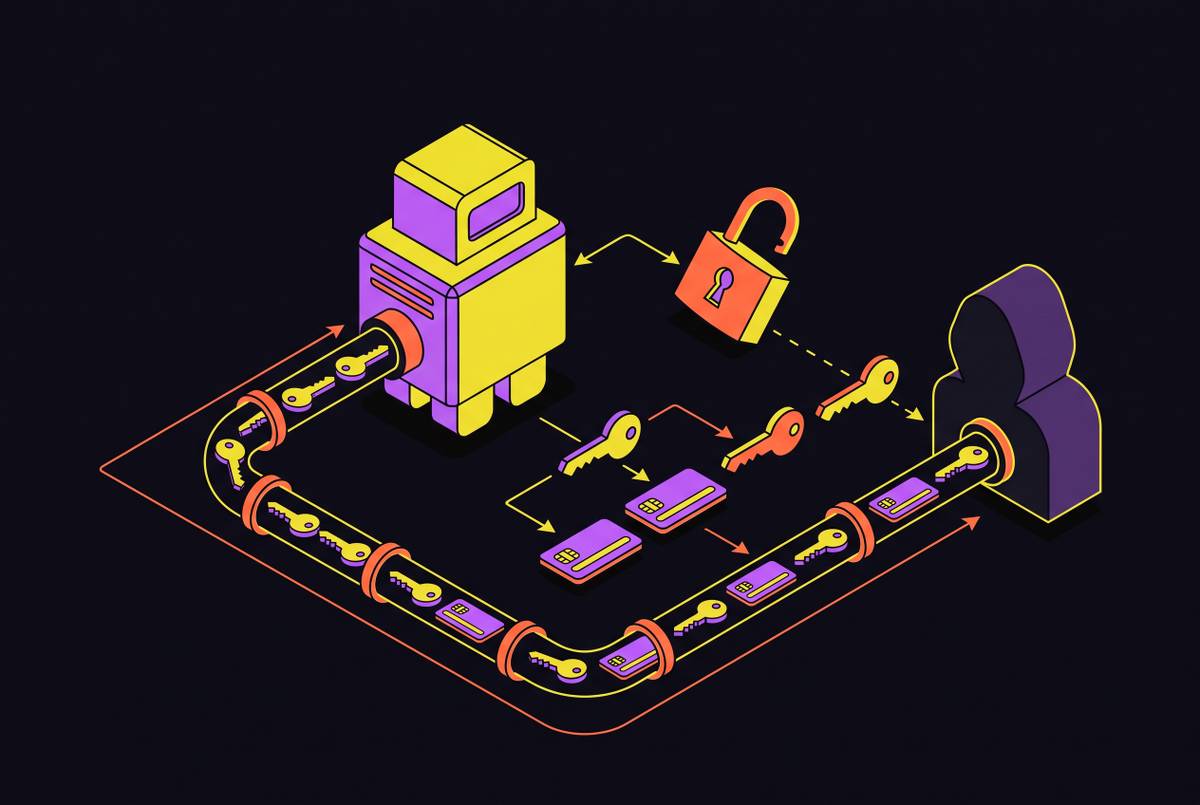
Start with non-human identity sprawl. Agents create machine identities with privileged access at scale, and traditional identity and access management is built around static policies and human login flows, so it has no good answer when privilege needs shift based on context and task. Most enterprises don't have a consistent way to provision an agent's credentials, track what it's doing with them, or retire them when the agent is decommissioned. The result: agents running with more access than they need and no clear record of who granted it or why.
Next, prompt injection and goal hijacking. OWASP ranks Agent Goal Hijack, listed as ASI01, as the top risk facing agentic applications today. The mechanism is simple to describe and hard to stop: an attacker gets manipulated text in front of an agent, and the agent, acting without a human checking each step, follows instructions it was never supposed to follow. Because the attack lives in meaning rather than in a file signature or a malicious IP address, it is what's called the semantic layer. A firewall can inspect a packet. It cannot tell you whether a sentence is trying to manipulate an AI system's behavior. In multi-agent setups, the risk compounds: a compromised agent can pass its manipulated instructions downstream to other agents that trust it by default.
Third, and arguably the hardest of the five to catch, is persistent memory poisoning. Prompt injection only works if its payload is present in the active context. Memory poisoning needs only one successful write. Once it's in, it can shape an agent's behavior indefinitely, with no single moment or file that shows up for a reviewer to catch later. This is the risk a traditional TPRM program is worst equipped to find, because there's no artifact left behind to audit. It's already happened in production. Microsoft 365 Copilot carried a vulnerability called EchoLeak, tracked as CVE-2025-32711 with a CVSS severity score of 9.3. Amazon Bedrock agents have carried vulnerabilities researched and disclosed by Palo Alto Networks' Unit 42. Microsoft's own Defender team found activity spanning multiple companies and industries where AI assistant memory was poisoned for promotional purposes, a technique MITRE now classifies as AML.T0080, AI Agent Context Poisoning (prompt injection itself carries its own MITRE classification, AML.T0051). A proof-of-concept called ZombieAgent, published by Radware in January 2026, showed that connector and memory features can combine to make an indirect prompt injection persistent and cross-session, spreading through something as ordinary as a malicious email, document, or webpage.
Fourth: cascading multi-agent compromise. Modern agentic systems often chain specialized agents together, one for retrieval, one for analysis, one for execution. When one of those agents is compromised, or simply hallucinates, it feeds bad data downstream to agents that trust its output by design, so the error amplifies as it passes from agent to agent. From the outside, the system looks like it's running normally right up until someone traces the failure back to its source, and that is why detection and incident response get so much harder here than in a single-agent setup.
Fifth: agentic supply chain risk. OWASP maps this as ASI04 in its Top 10 for Agentic Applications 2026, the risk that an agent's behavior gets compromised through a vulnerable or malicious third-party component, a tool, a plugin, an MCP server, a prompt template, or a data source feeding retrieval-augmented generation. This is a bigger problem than classic software supply chain risk, because the failure mode isn't only malicious code slipping into a build. It can be a manipulated prompt, poisoned retrieval content, or a tool that overreaches what it was scoped to do. Layer on top of that the problem of nth-party risk, the risk introduced by your vendor's vendors, and the picture gets harder still. Tracking that by hand is close to impossible, and no platform in production today reliably maps that exposure past the second or third tier out.
Why the governance gap is widening faster than deployment
None of the five attack surfaces above are hypothetical. What makes them urgent is the pace at which enterprises are deploying agentic systems into production, often while still running governance models designed for a workforce of humans, not agents.
A large majority of companies plan to deploy agentic AI within the next two years. Only a few currently have a mature governance model built for AI agents specifically. Deployment velocity and governance maturity are heading in opposite directions because two processes run on different clocks: product teams move at the speed of a release cycle, while governance reform moves at the speed of policy, budget, and cross-functional buy-in.
The identity accountability gap sits at the center of this. Most enterprises still have no consistent way to provision, track, and retire credentials for AI agents specifically. Agents accumulate permissions and keep them, often with no clear record of who approved what access or when it should expire.
The AI inside the risk function is itself a third party worth assessing. When a model generates a control attestation summary, hallucinates a finding, or drifts in accuracy as vendor document formats change over time, the risk program inherits that error directly. Who's checking the checker? Organizations need a real answer to how the accuracy of that AI is measured after deployment, and what the escalation path looks like when the model gets something wrong.
Without end-to-end traceability across an agentic workflow, a security team can't reconstruct what happened after an incident. That's a compliance problem. It's also an incident response problem, and increasingly, a regulatory one. The threats piling onto this gap in 2026 aren't abstract either: AI-powered attacks aimed at vendor ecosystems, supply chain attacks exploiting relationships that were trusted by default, and deepfakes used to impersonate vendors in ways a phone call used to rule out instantly. Every one of these gets amplified by the same governance void.
What regulators have established and left unresolved
Regulators haven't ignored any of this. Several jurisdictions have moved fast, but what they've built still leaves gaps enterprises have to close on their own.
Singapore's IMDA produced the first comprehensive governance framework built specifically for autonomous agents in January 2026, and it requires every agent to carry a verifiable digital identity along with an audit trail showing which agent acted under whose authorization. The 2026 Singapore Consensus on Global AI Safety Research Priorities, through its Companion Report on Agentic AI Risk Management, lays out ten foundational principles for managing agentic risk: least privilege, traceable identity, auditability, validated deployment, adversarial resilience, multi-agent stability, runtime assurance, interruptibility, legibility, and human oversight. A national standards body's cybersecurity center released a concept paper in February 2026 addressing software and AI agent identity and authorization, and it names the gap: agents are commonly treated as generic service accounts, with no dedicated identity, authorization, or accountability controls of their own. In financial services, a regional digital operational resilience framework covers ICT risk and third-party dependence, applicable to AI vendors but not written with agentic architectures in mind. The EU AI Act is in force and classifies risk tiers, but as of early 2026 the AI Office still hasn't published dedicated guidance on AI agents, autonomous tool use, or runtime behavioral change. Its Service Desk FAQ touches the topic, and even that entry describes regulatory thinking on agents as "only preliminary."
Liability is where the open questions concentrate. Several jurisdictions, including the EU through the AI Act, California through AB 316, and Singapore through its Model AI Governance Framework for Agentic AI, have established liability frameworks that extend to autonomous agents. What none of them have built is a liability framework purpose-made for the specific case of an agent acting outside its mandate. The EU AI Act classifies risk by tier, but it doesn't say who answers when a delegated agent does something nobody authorized. One major jurisdiction has no federal legislation governing AI agent identity. No technical standard yet covers the full delegation lifecycle an agent moves through, from provisioning to runtime behavior to credential retirement. A payment agent that touches stablecoins, third-party models, and cloud-hosted tools in the same workflow can't be governed by a single regulatory lens, and right now, that kind of multi-regime exposure is largely left to the enterprise running it.
Why continuous, AI-specific monitoring is a structural necessity
Everything above points to the same conclusion. Agentic AI risk is dynamic, it operates at the level of meaning rather than traffic, and it runs several tiers deep into a supply chain no questionnaire reaches. Continuous monitoring built specifically for AI behavior is the only mechanism that can catch what a point-in-time review structurally cannot.
Four properties of agentic risk explain why the old review cycle will keep falling short, no matter how often it runs. Behavior is dynamic: an agent's risk profile can shift between reviews as it gains new tool access, new memory, or new instructions, so a questionnaire filed at onboarding says nothing reliable about the agent's state six months later. The attack surface is semantic: prompt injection and memory poisoning operate at the level of meaning, not traffic or file signatures, so only monitoring built to watch runtime behavior has a chance of catching them. Supply chain exposure runs several tiers deep: tools, plugins, MCP servers, and RAG data sources carry risk that no vendor questionnaire was ever built to surface, and continuous external telemetry is the only practical substitute for mapping it. And non-human identity drifts over time: agent credentials accumulate permissions without the checkpoints that normally govern a human employee's access, so only ongoing monitoring of credentials and permissions can surface excessive access before someone exploits it.
What follows from that is a different job description for monitoring itself. It has to track an agent's identity and authorization across its full lifecycle, from the moment it's provisioned, through every action it takes at runtime, to the moment its credentials are retired. It has to flag behavioral drift in an agent's outputs and decision patterns as they happen, not traffic patterns after the fact. None of the five attack surfaces described earlier leave an annual questionnaire anything to find. The governance gap and the regulatory gaps described above aren't going to close on their own timeline either. What's left is the work of building, inside the enterprise, the kind of continuous watching that the moment actually calls for.
Sources
- The 2026 Singapore Consensus on Global AI Safety Research Priorities
- A Systematic Survey of Security Threats and Defenses in LLM-Based AI Agents: A Layered Attack Surface Framework
- From AI-Generated Content to Agentic Action: Security and Safety Threats in Generative AI
- The AI Agent Governance Gap: What CISOs Need Now
- EY survey finds that autonomous AI implementation outpaces oversight, yielding an AI governance gap
- Agentic AI Governance: NIST Standards for Autonomous Systems
- Trustworthy Agentic AI: Failure Modes, Mitigation Strategies, and a Lifecycle Framework for Autonomous LLM Systems