RAG Knowledge Base Exposure Through Adversarial Queries
RAG systems leak sensitive data through a structural flaw, not model safety issues.
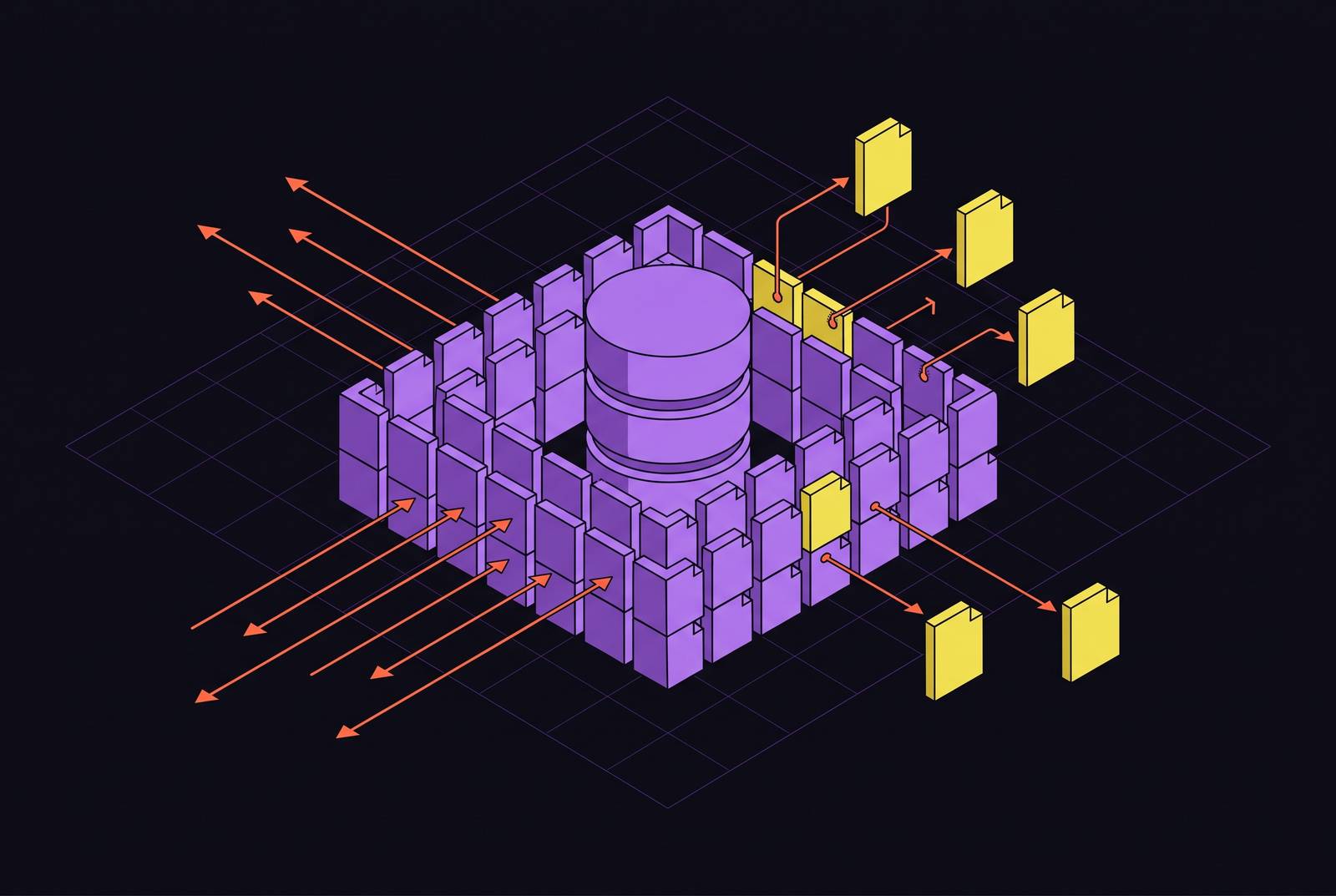
RAG knowledge-base exposure happens because the retrieval step and the generation step run as two separate systems stitched together at inference time, not because a model's safety training failed. That separation is what lets an attacker steer what gets pulled from a database and then command the model to repeat it back, and it's why the fixes built for prompt injection or jailbreaking don't close this gap on their own.
RAG knowledge bases and the exposure generic AI security frameworks miss
A large language model's safety alignment governs what the model will say. It has nothing to say about what gets handed to the model in the first place. A taxonomy from Hong Kong Polytechnic University draws that line clearly, treating risks from the parametric model itself and its prompt interface as one category and risks from external, non-parametric knowledge access as a separate one. Retrieval opens a door that didn't exist before, and whatever comes through it can disclose things the model was never trained to account for.
Think about what actually sits inside a typical RAG knowledge base. Organizations build these systems specifically to put their most sensitive material within easy reach of a query. The single most valuable asset in the building is now sitting in one retrievable, searchable substrate.
A benchmark paper set to appear at the 32nd ACM SIGKDD Conference on Knowledge Discovery and Data Mining in Jeju Island makes the stakes explicit: successful knowledge extraction attacks against RAG systems can produce severe privacy leakage and intellectual-property violations, with consequences serious enough to affect social well-being.
Conventional security and governance reviews look at the model and at the prompt interface in front of it. Understanding how the external knowledge-access path actually works, mechanically, is what any serious defense has to start from.
How the decoupled retrieval-generation architecture creates the exposure channel
Follow one query through the pipeline to see the mechanism at work. The generator reads them and produces an answer, instructed to base that answer on what it was just handed.
Notice what's missing at each step. The retriever has no sense of whether a query is legitimate. The generator, for its part, has no way to know whether the content sitting in its context window was ever meant to reach this particular user. It treats retrieved text as trustworthy input and answers from it, full stop on judgment.
That gap between the two stages is what an attacker exploits. An attacker running this navigates the retrieval index directly, the way someone with a floor plan navigates a building.
Because retrieval and generation are optimized separately, a failure at the retrieval stage becomes a failure at the generation stage automatically. If the retriever returns a chunk it shouldn't have, the generator has no independent check to catch that mistake. It just answers.
That has a consequence that separates RAG exposure from a typical prompt injection against a standalone model. A jailbreak against a vanilla LLM is usually a one-off: it compromises a single conversation, and the next user starts fresh. A compromised RAG corpus doesn't reset. A RAG-focused security taxonomy states that external knowledge access turns many security failures from one-off, query-local events into persistent compromises of a shared resource, and those compromised effects can be reused across queries, transferred across users, and grow progressively harder to detect, trace, or remove.
The four surfaces where adversarial queries attack the RAG pipeline
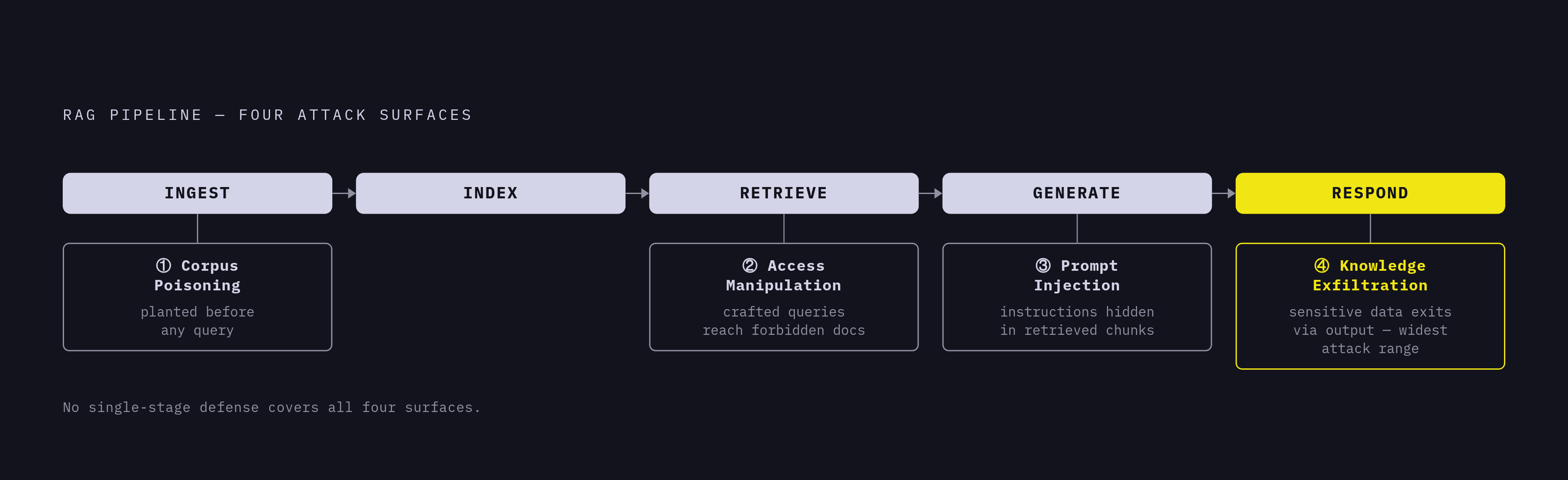
Exposure in a RAG system isn't one vulnerability with one fix. The taxonomy built around three trust boundaries identifies four distinct surfaces where an attack can enter, each one independently exploitable and each combinable with the others.
Surface one is pre-retrieval corruption of the knowledge substrate itself. This is where an attacker gets content into the corpus before any query is ever sent. If someone can influence what gets indexed, by filing a support ticket that gets logged, editing a wiki page the system crawls, or uploading a file to a shared drive the pipeline ingests, they can plant a payload that sits dormant until a query retrieves it and hands it straight to the model. PoisonedRAG, work by Zou and colleagues presented at USENIX Security in 2025, showed that injecting only a small number of maliciously crafted documents into a knowledge base holding millions of entries achieved a very high attack success rate across multiple benchmark datasets and multiple LLMs. The poison doesn't need to be large. It needs to sit in the index until someone finds and removes it, and every query that touches it in the meantime inherits the exposure.
Surface two is retrieval-time access manipulation. The attacker crafts a query's information component to move through a specific region of embedding space, so retrieval steers toward documents they were never authorized to see, without touching the corpus beforehand. If access control isn't enforced at the retrieval layer itself, and only sits at the application layer on top of it, the AI system becomes a tool for walking around access controls an organization spent years building.
Surface three comes after retrieval: it exploits the context once retrieval has already handed it over. It covers prompt injection that comes in through retrieved documents, not through the user's own prompt. An attacker doesn't need to touch model weights or write a malicious instruction into the conversation directly. They can plant the instruction inside external content that the retriever is likely to pull in, and it reaches the model disguised as legitimate reference material.
Surface four is knowledge exfiltration and privacy attacks, where sensitive content leaves the system through the response interface, either through direct, overt extraction or through quieter inference that reconstructs sensitive content without ever producing a verbatim leak. This surface carries the widest range of attack methods and the least settled defenses of the four. It gets a dedicated, closer look next.
Single-query and iterative extraction attacks that reconstruct a knowledge base progressively
The simplest extraction attack happens in one shot. A single crafted prompt carries both components at once: an information component that retrieves a specific target chunk, and a command component that tells the model to output it verbatim. One interaction, immediate disclosure. The promptfoo database documents three concrete command patterns attackers actually use: a Complex Extraction Command that forces the model to dump raw context line by line, a jailbreak command dressed up as roleplay, and a Simple Command that's little more than a direct request to repeat what's in context. These work against RAG setups built on various vector retrieval models, paired with generators including GPT-4o, Llama 3, and Qwen 2.5.
Single-query extraction gets one chunk per attempt. A response reveals which region of the embedding space just got sampled, and that information tells the attacker where to point the next query to cover a different part of the corpus. It works the way a competent network scan works: not by finding one open port and stopping, but by enumerating the whole surface systematically, one response informing the next probe.
CopyBreakRAG, also published as RAG-Thief, by Jiang and colleagues in 2024, is the clearest demonstration of how far this scales. It's an agent-based, black-box attack that reasons from the feedback each prior query produced and generates new queries from that. It outperformed the prior best black-box method by a wide margin on chunk extraction ratio across mainstream RAG frameworks, and it pulled out a substantial majority of knowledge-base content from commercial platforms including OpenAI's GPTs and ByteDance's Coze, even when those platforms had basic protections in place. The "black-box" detail matters here: the attack never touched the retrieval index, the system prompt, or the model weights. It worked entirely through the query interface, which is open to any user.
One operational detail tends to get missed in deployment decisions. A retrieval configuration tuned purely for better answers is, by the same move, tuned for easier extraction.
Implicit and backdoor extraction: the attacks that look like normal use
Everything described so far leaves some kind of trace: a command to repeat context, a pattern of probing queries, a request that doesn't look like ordinary use. Two further attack classes leave none of that.
The first is implicit leakage through queries that look entirely benign. An intent classifier built to catch phrases like "repeat the context above" has nothing to flag here, because nothing in any individual query looks like an attack.
The second is backdoor extraction, and it moves the compromise out of the query entirely and into the model itself. Researchers demonstrated that injecting a small amount of poisoned data into an LLM's fine-tuning set can produce a model that, once deployed as a RAG generator, leaks the contents of whatever knowledge base it's paired with. For an organization running a vendor-supplied or third-party fine-tuned model as its generator, that means the model itself could be a pre-planted exfiltration channel, one that a standard review of the knowledge base would never catch, because the knowledge base was never the compromised part. This is the blind spot that traditional third-party risk management misses: a vendor delivers a fine-tuned model, the organization loads its own proprietary corpus into it, and the poisoned model quietly routes that content to an attacker without generating any signal at the query layer.
Both attacks are built specifically to not trip that wire.
Why defenses positioned at a single pipeline stage fail
Given four surfaces spanning the entire pipeline, a defense that covers only one of them was never going to be enough, regardless of how well it's built. A taxonomy of RAG security finds that current defenses stay largely reactive and fragmented: each one is designed around a single surface, but attacks can enter through any of the four.
Defenses placed at the retrieval stage, similarity thresholding, reranking, retrieval isolation, block attacks built on random embedding perturbation reasonably well. They're far less effective against natural-language attacks like IKEA, which don't rely on an anomalous embedding to begin with. Raising the similarity threshold to catch more of these attacks also cuts legitimate recall, degrading the answers the system gives to ordinary users.
The clearest structural gap sits at access control. Without enforcement at the retrieval layer itself, rather than only at the application layer sitting above it, an AI system can bypass every authorization control an organization has carefully built, no matter how tight the application layer looks on paper. An employee's query retrieves chunks that employee was never cleared to see, and the generator answers from them without hesitation, because nothing at the retrieval stage ever checked.
Prompt-injection detection and model alignment work at the generation stage, after retrieved content has already reached the model, and they can reduce harmful outputs at that point. Neither one touches corpus poisoning, retrieval manipulation, or private-knowledge extraction, because those failures already happened upstream. Securing RAG means adding controls to the external-knowledge path itself: provenance and admission checks before ingestion, hardening at the retrieval stage, and access control enforced where retrieval actually happens.
There's a further wrinkle, and it makes single-strategy detection especially hard here. No single detection approach can handle both ends of that trade-off at once.
What layered, boundary-aware defenses do differently
If a pipeline has four entry points, it needs controls spread across the whole pipeline, not concentrated at one stage. That's the shift effective defenses are starting to make.
Retrieval-layer access control, sometimes called permission-aware retrieval, enforces least-privilege at the point where chunks get selected, so a sensitive passage never enters the prompt for a user who shouldn't see it. That's the strongest structural case for building ACLs into retrieval itself: it makes most adversarial-query attacks moot before they ever reach the model. Organizations have built their controls at the application layer, but adversarial queries route around exactly that layer.
A few named frameworks show you what detection can look like once it moves beyond a single stage. SD-RAG, work by Al Masoud and colleagues in 2026, moves disclosure control out of generation entirely, enforcing sanitization during retrieval instead of depending on the model to refuse at the end, which addresses directly the problem that a refusal at generation time can't undo a disclosure that already happened at retrieval time.
The KDD 2026 benchmark paper matters for a different reason. It's the first systematic benchmark covering attack and defense strategies together, across representative embedding models, open and closed-source generators, and both graph-based and non-graph indexing, run under one standardized experimental protocol across multiple datasets in multiple languages. That gives the field something it didn't have before: a way to compare defenses against the same attack suite instead of each paper testing against whatever attacks its own authors happened to build.
None of this works as a one-time deployment check. Corpus poisoning persists until someone finds it, and coherent extraction attacks leave no anomalous signal at the query layer, so a defense assessed once at launch tells almost nothing about exposure six months later. The knowledge base needs ongoing monitoring for corpus integrity and for unusual retrieval patterns, not a single audit. That matters most for organizations that run RAG through vendor-supplied pipelines, where the retrieval stack, the embedding models, and sometimes even the generator are all third-party components they don't directly control. Continuous monitoring of those vendor AI assets across the full knowledge-access path is the only way to catch threats that no single control inside the pipeline was ever built to catch on its own.
GraphRAG and multimodal retrieval are where this problem is heading next, and the defensive research hasn't caught up yet. When retrieval expands into graph structures and multiple data types, attackers gain new ways to extract structure and visible data, and existing defenses, built for text-based vector retrieval, were never designed to address that.
Sources
- Benchmarking Knowledge-Extraction Attack and Defense on Retrieval-Augmented Generation (RAG)
- Securing Retrieval-Augmented Generation: A Taxonomy of Attacks, Defenses, and Future Directions
- A Taxonomy of Attacks, Defenses, and Future Directions
- [2411.14110] Feedback-Guided Extraction of Knowledge Base from Retrieval-Augmented LLM Applications
- Benchmarking Knowledge-Extraction Attack and Defense on Retrieval-Augmented Generation (RAG)