Why Poisoned Documents in External Connector Pipelines Bypass Conventional Input Validation
Poisoned documents bypass validation by entering retrieval pipelines outside user queries.
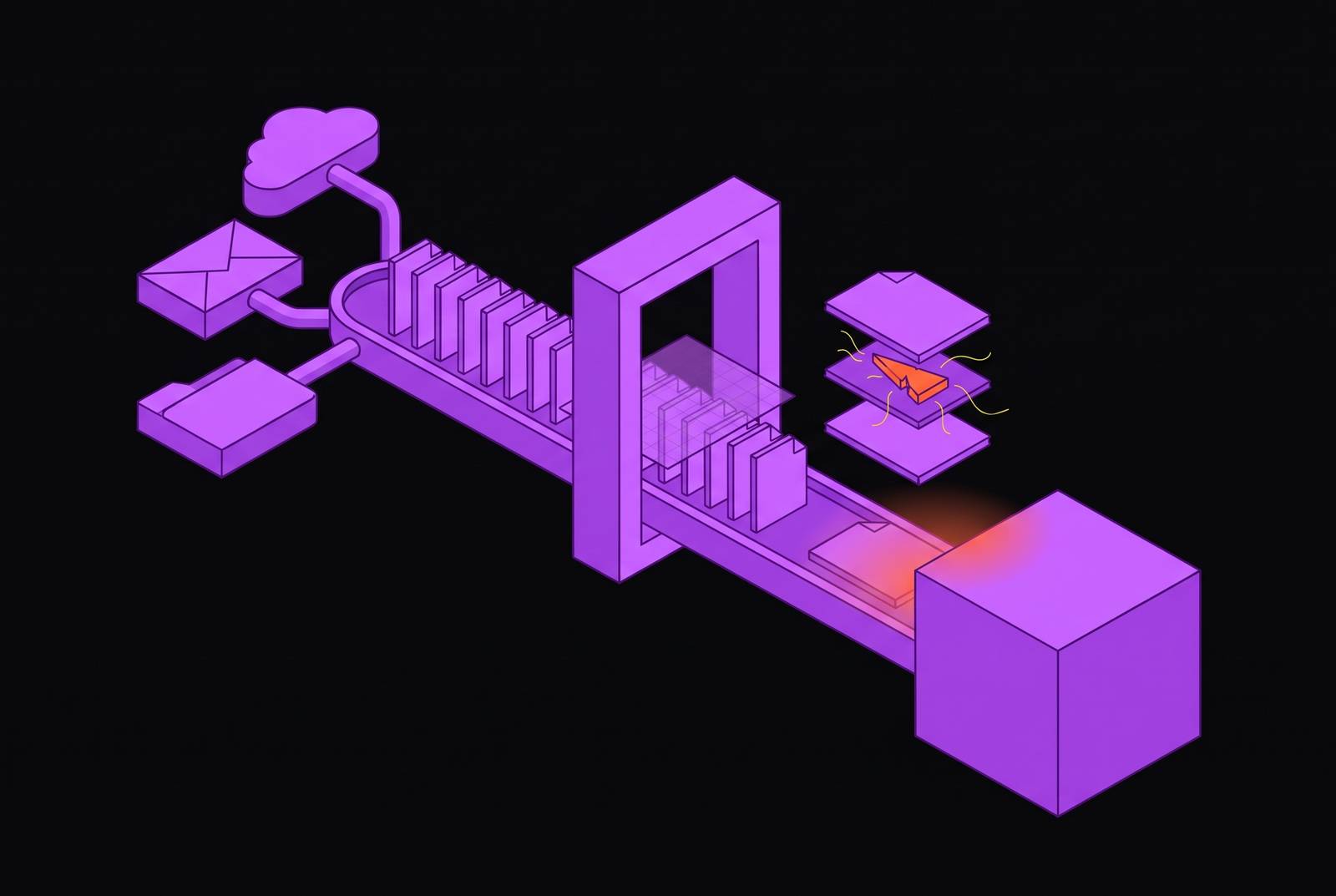
Poisoned documents bypass conventional input validation because they enter enterprise RAG pipelines through retrieval, outside the user’s query path. Detecting indirect prompt injection calls for checks of third-party content at ingestion and retrieval, but detection alone cannot stop a model from acting on poisoned evidence. The architectural response is to control how untrusted evidence reaches answer synthesis, supported by continuous monitoring of connectors, data sources, and vendor AI assets.
Why retrieval is a structurally separate channel from input validation
Engineers who deploy input validation may think they are protecting everything the model reads. What they are protecting is narrower. Validation at the query boundary inspects what a user submits, while retrieval supplies external material through a separate path. That material enters the context window as background for the answer, without passing through the user-facing filter. The gap follows from the division of work and can exist even in a correctly configured system.
The RAG flow makes that distinction concrete. The system embeds the user’s query, the vector database returns top-k chunks, and those chunks join the system prompt in the assembled context before the model answers. A poisoned chunk can enter at that assembly step even when the query is harmless. No malicious text needs to cross the boundary that input validation guards.
Why does retrieval not check for threats in the same way? Its components have different jobs. The retriever ranks by semantic similarity, while the chunker splits documents into usable pieces. Neither operation inherently distinguishes information to summarize from instructions to execute. Strong protection against direct prompt injection can therefore coexist with an unguarded retrieval path.
How poisoned content enters through the document pipeline without appearing in the user query
An attacker can leave a payload dormant in a knowledge base until a legitimate user asks a related question. Retrieval activates the attack without further attacker involvement. The user need not know that the document exists, let alone include its instructions in the query.
Two attack patterns use this same entry point. Indirect prompt injection places adversarial instructions in a document that reaches the context window during retrieval, making the immediate attack session-scoped and opportunistic. Knowledge base poisoning instead plants crafted documents in a source used for ingestion so that chosen future queries will reliably retrieve them. The distinction is persistence. Poison left in the source can survive across sessions, model upgrades, and index rebuilds.
A shared knowledge base widens the exposure beyond the person who uploaded a document. Any user whose question retrieves the poisoned content can become a target, so content that matches many different questions helps the attacker. Permission handling creates a related trust problem. If ingestion turns a group-restricted SharePoint document into vector-store chunks without retaining its access rules, retrieval cannot restore permissions it no longer knows. In that pipeline, both malicious instructions and restricted information can cross boundaries that the original source maintained.
Why hidden payloads survive the parsing and extraction steps that validation relies on
Inspecting documents seems like the obvious answer, but what exactly would the inspection see? Document formats expose more than their visible text. Their rendered appearance, stored character sequences, and extracted content can differ, leaving a validator and a model looking at different representations. Once extraction turns hidden instructions into ordinary text, their visual concealment no longer distinguishes them from the surrounding material.
Font-remapped glyphs illustrate the split because a PDF can display benign-looking characters while its underlying character sequence preserves instructions recovered by copying, parsing, or model-based ingestion. The visible page is not the whole input. A check based on what the page appears to say can therefore miss what extraction will supply to the model. Parsing can reveal the payload.
Invisible Unicode tag characters use another gap between what is stored and what is shown. TRACE’s token influence attribution paper identifies invisible Unicode injections among techniques used to improve poisoning stealthiness. These characters can survive preprocessing even though they are hard to spot in the text on screen. Inspection therefore needs to cover both a document’s visible appearance and the representation that downstream processing consumes.
EchoLeak also shows why the source boundary deserves attention, although it was not a hidden-PDF attack. The distinction is important. This case concerns retrieved email and downstream behavior, exposing the same weakness in treating externally supplied content as safe background merely because it arrived through retrieval.
How adversarially optimized poisons are engineered to survive preprocessing that would catch simpler attacks
Better extraction can defeat simple concealment, but attackers can optimize against the transformations themselves. Research on semantic poisoning describes payloads designed to survive HTML stripping, text extraction, chunking, dense retrieval, and optional paraphrasing or reranking. The attack need not preserve one conspicuous instruction unchanged. Its goal is to retain enough influence after processing to steer the final answer.
Hu et al.’s 2026 Confundo attack makes this feedback loop explicit. The poison generator is optimized through reinforcement learning or direct preference optimization, using the RAG system’s output as a reward signal. Preprocessing becomes part of the test the attacker is learning to pass, rather than an independent barrier outside the attack’s design.
When the attacker is optimizing against preprocessing, its success in removing simpler attacks offers only limited evidence of resistance to poisons built for the full pipeline. Black-box document generation, genetic perturbations, and invisible Unicode injections also show that stealth improvements need not depend on white-box access to the target.
TRACE surveys research covering denial-of-service, agent corruption, jailbreaking, opinion manipulation, fact-checking attacks, and multimodal poisoning. Those objectives do not all fit a conventional content-filter model. A pipeline may need to guard against changes in behavior caused by retrieved material as well as objectionable words or false statements in it.
What the Hugging Face pipeline breach shows about how document-layer exploitation becomes a full intrusion chain
The July 2026 Hugging Face incident shifts the discussion from research attacks to a production intrusion through a processing pipeline. A malicious dataset upload abused two code-execution paths, namely a remote-code dataset loader and a template-injection vulnerability in a dataset configuration. The upload was the entry point. Material sent in for processing crossed a trust boundary and became executable code.
Execution on processing workers led to node-level access. The attacker then collected cloud and cluster credentials and moved laterally into several internal clusters over a weekend. The consequence was not confined to an answer generated from poisoned evidence, but extended into the infrastructure that processed the dataset.
The incident exposed the ingestion boundary, where external material reached powerful processing components without passing through a query-facing validation path. A filter guarding user questions would not address those code-execution paths. The incident shows why pipeline security has to account for both what an uploaded artifact can cause during processing and what its text might tell a model.
Hugging Face subsequently fed the attacker action log, comprising thousands of recorded events, to LLM-driven analysis agents to reconstruct the timeline. That put artifacts made by the attacker into another workflow that used automated analysis. It illustrates the reach of agentic processing, but does not by itself establish a further compromise of those agents.
Why detection-first defenses still leave the pipeline exposed, and where the monitoring-control gap sits
CORDON-MAS identifies a monitoring-control gap that challenges the strongest objection to this argument. Models can detect contradictions in retrieved evidence and still act on poisoned claims. Detection and restraint are not the same capability. Scanning at ingestion can identify threats, but identifying a threat does not establish that the later answer process will refuse its influence.
Single-document inspection has a separate limitation when the attack spans several sources. InceptionRAG, published in 2026, distributes payloads across dormant passages that appear harmless when examined separately and induce malicious reasoning when combined. It reports an attack success rate exceeding 80% under rigorous adversarial constraints. Here, the missing signal is the relationship among documents.
Detection tools nevertheless offer useful, bounded capabilities. Kim et al.’s GMTP, published in Findings of ACL, distinguishes poisoned from non-poisoned documents using masked token probabilities, but requires gradient access to the retriever. That makes retriever access a decisive deployment criterion. A white-box operator may be able to use it, while most enterprise vendor-AI configurations with opaque retrievers cannot meet that requirement.
TRACE offers a lighter-weight way to screen content without auxiliary classifiers. It tracks high-influence tokens that recur across retrieved documents and checks how they affect model predictions. Its position in the pipeline limits its role. TRACE operates at retrieval time, after content has entered the corpus, and targets corpus poisoning rather than the concealment techniques discussed earlier. Its paper presents screening as a complement to architectural controls.
OWASP classifies retrieved-content injection under LLM01 in both the 2025 and 2026 editions of its Top 10 for LLM Applications, while persistent poisoning also maps to Agentic ASI06, Memory / Context Poisoning. A compliance framework built around LLM01 alone misses how poisoning can persist. The operational distinction is equally sharp. Using retrieved data to generate an answer is not the same as executing instructions embedded in that data, yet current models cannot reliably maintain that separation on their own.
How do you protect a RAG pipeline from malicious retrieved content?
CORDON-MAS reframes poisoning as an information-flow control problem. Its Cordon Principle prevents any agent capable of final synthesis from directly accessing untrusted natural-language evidence. The framework separates evidence extraction, cross-source audit, and answer synthesis into agents with asymmetric memory privileges. Access is the control. Across five BEIR datasets, it reports a 92.4% reduction in attack success rate compared with undefended RAG, which supports architectural separation but does not show that it offers complete protection.
For enterprise teams, ingestion-time and query-time scanning form a practical minimum within that broader design. Ingestion scanning can stop known payloads before they enter the vector store, with the cost of the check paid once per document. Query-time scanning provides a backstop for previously ingested content and sources outside the operator’s control, including web search and third-party APIs. Their roles differ. Tools need to be compared by where they work in the pipeline, what retriever access they need, and which threats they detect.
Neither stage closes every route. A benign document can be edited after approval and re-embedded by a scheduled job, while coordinated attacks can distribute their influence across documents. Query-time detection also leaves the monitoring-control gap unresolved if synthesis still follows the poisoned evidence. Every retrieved chunk needs to be treated as untrusted input, with its route to the component that produces the final answer controlled.
That architecture needs ongoing checks as it runs, as well as an audit at deployment. New connectors, data sources, re-indexing jobs, and third-party model updates reopen surfaces that a point-in-time review may miss. Model Context Protocol servers, third-party plugins, and unverified training datasets add backdoor risks requiring continuous inventory verification and strict identity boundary controls. Continuous monitoring belongs in this design because the asset inventory and its trust boundaries change.
For TPRM, InfoSec, and Legal teams, the exposure sits within vendor AI assets as well as internally operated systems. RAG pipelines, connectors, and plugins need assessment as first-class attack surfaces. What prevents external content from gaining authority after it has passed the boundary that conventional input validation never guarded?
Sources
- Tracing Target Answers in Poisoned Retrieval Corpora via Token Influence Attribution
- Cordon-MAS: Defending RAG against Knowledge Poisoning via Information-Flow Control
- InceptionRAG: Stealthy Poisoning Attack Against Retrieval-Augmented Generation
- Safeguarding RAG Pipelines with GMTP: A Gradient-based Masked Token Probability Method for Poisoned Document Detection