Vendor AI Connector Data Flows and Exfiltration Risk
How forgotten OAuth tokens and unmonitored AI connectors become data exfiltration highways.
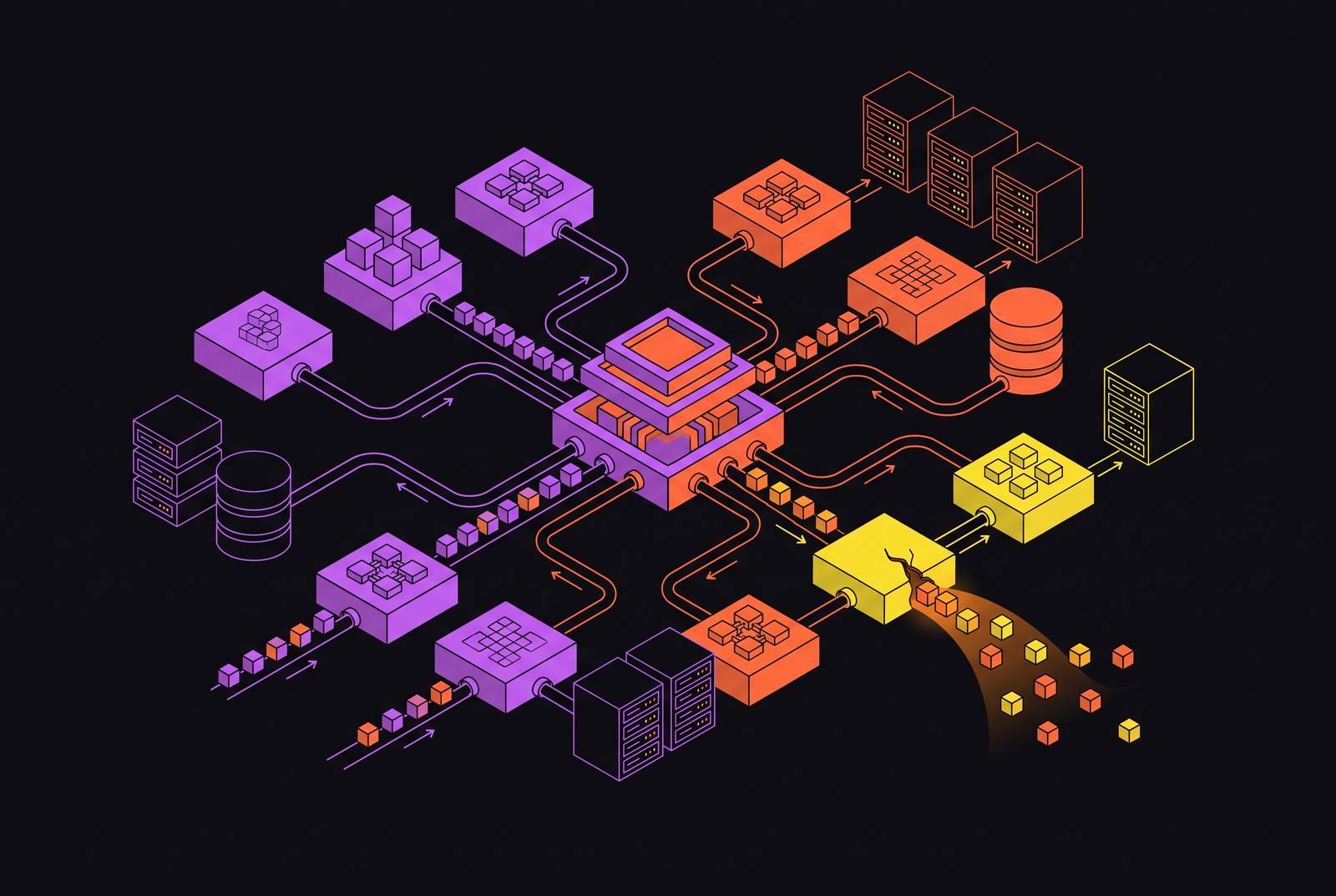
Most enterprise data doesn't leak through the front door anymore. It leaks through the connectors your employees granted access to months ago, then forgot about. This piece maps how data moves through vendor AI connectors, where control breaks down at each hop, and why the connector layer is a different kind of risk than anything third-party risk management has faced before.
Why vendor AI connectors are a structurally different risk than prior third-party integrations
Traditional SaaS integrations moved data between two parties with known controls. You knew where the data lived and who could touch it. That model made sense for a world where integrations were point-to-point and human-paced.
Vendor AI connectors break that model entirely. An OAuth integration, an MCP bridge, or an agentic tool chain moves data automatically through multiple hops, and each hop may land in a sub-processor you never directly contracted with. A primary model can handle a prompt safely while the same content is simultaneously written into an analytics platform, an error log, or a third-party integration with different retention rules. This is not a configuration failure. It is structural. The protocol was designed for frictionless connectivity, not least-privilege data movement.
Three distinct mechanisms drive most of the connector-layer risk. First, OAuth tokens have become the attack surface. Threat actors steal authentication tokens to impersonate trusted applications, bypassing MFA and moving laterally into customer environments without triggering anomaly detection. The access looks like a legitimate integration operating within normal permission flows, so nothing flags it. Second, MCP acts as a privilege amplifier. The protocol lets users grant agents broad access to multiple sensitive systems, a data warehouse, an issue tracker, email, customer support, in a single configuration. Third, shadow AI creates unmapped connectors. AI features arrive inside approved SaaS products rather than as standalone applications, so they never appear in software inventories. Cycode's 2026 AI security analysis identifies shadow AI as producing ungoverned data flows and compliance blind spots, because security teams cannot apply retention, access, or monitoring rules to a tool they do not know exists.
These three mechanisms compound one another. Shadow AI creates the unmapped connectors. MCP amplifies whatever access those connectors carry. And OAuth becomes the lever attackers pull when they find a token that still works. That combination is what makes the connector layer a categorically different attack surface, not just a variation on an old problem.
How data actually moves through a connector chain, hop by hop
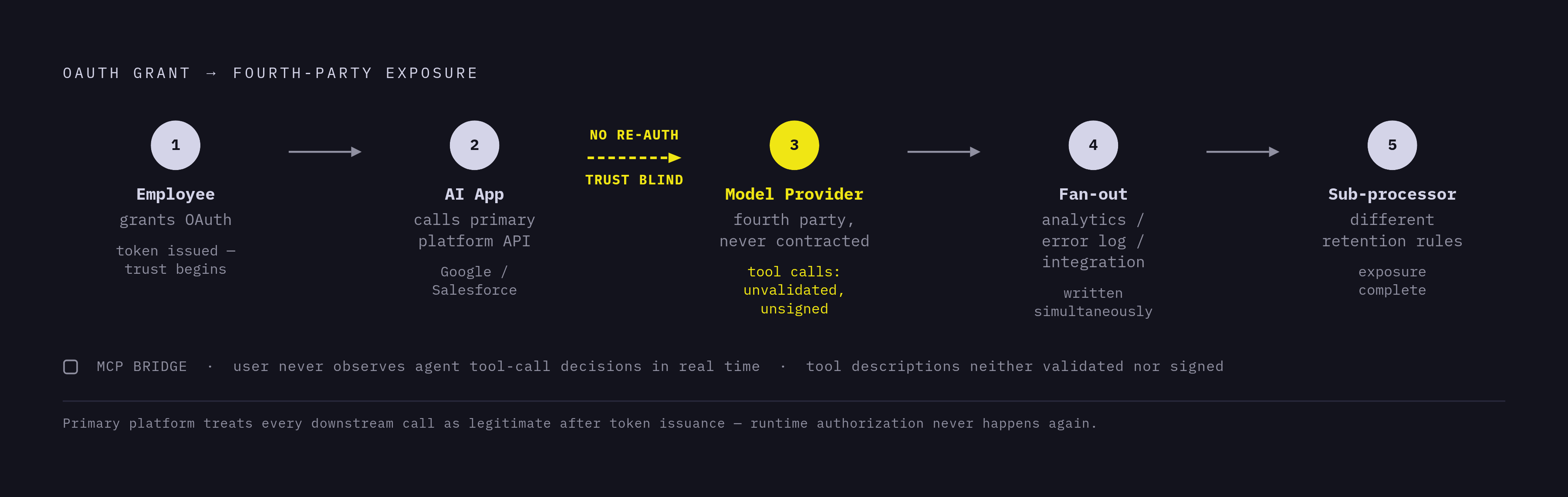
To see where control breaks down, you have to follow the data itself. Start with an OAuth integration. First, a user grants an AI application OAuth access to a primary platform such as Google Workspace or Salesforce. At each use, the application calls the primary platform API, retrieves data, and may pass it to a model provider. That model provider is a fourth party the enterprise never directly contracted with. The critical gap sits right after the token is issued. The primary platform sees all subsequent API calls as legitimate. There is no runtime check that the requesting application is still authorized, still in scope, or uncompromised.
Now consider an MCP bridge. An MCP server exposes tool descriptions to the AI agent. The agent reads those descriptions and decides which tools to call. The user neither makes nor observes that decision in real time. Blackfog's 2026 analysis of agentic AI exfiltration risks documents what happens when a poisoned tool description enters that flow. The description is invisible to the user but fully visible to the model. It can embed hidden instructions that redirect the agent's behavior, including rewriting how a messaging integration sends outbound messages to silently route data to an attacker-controlled destination. The gap here is that tool descriptions are not validated or signed. The agent has no mechanism to distinguish a legitimate description from a weaponized one.
Agentic tool chains add another layer. Enterprise platforms often deploy multiple specialized agents that collaborate: one reads a support ticket, another queries customer records, a third updates a system of record. Blackfog's analysis establishes that any text one agent ingests becomes an instruction surface for the entire chain. Inter-agent trust is architectural. Agents are designed to comply with instructions from other agents, so there is no native skepticism about the source of an instruction.
There is also the fourth-party problem inside the vendor's own product. A vendor's AI feature may process enterprise data through a foundational model the enterprise never selected, evaluated, or contracted with. Promptarmor's assessments track not just the connector protocol but the full chain of sub-processors and their actual data handling, which is where older governance checklists go quiet. Organizations deploying vendor AI connectors need visibility into these flows continuously, not just at contract signing, as connector architectures and sub-processor configurations change.
Where control actually breaks down: four documented failure points
The failure points are consistent across connector types. Poisoned content travels as trusted input. And supply chain substitution replaces a legitimate package with a malicious one.
The first failure point is dormant credentials. Credentials issued for a prototype integration and never deactivated remain valid and exploitable years later. The Klue incident on June 11 and 12, 2026, illustrates this precisely. Why did monitoring miss it for a day? Dormant credentials are invisible to tools looking for active anomalies. Their first use after years of inactivity registers as a normal authentication event.
The second failure point is over-permissioned OAuth grants that persist beyond the relationship. In April 2026, a Vercel employee had trialed Context.ai months earlier, granting the app durable access to their Google Workspace. The decisive issue was not the compromise of Context.ai itself. It was the persistence of access granted during a trial period that the employee believed had ended.
The third failure point is zero-click prompt injection through trusted content channels. EchoLeak, tracked as CVE-2025-32711 with a CVSS score of 9.3 and disclosed in June 2025, showed how attackers could exfiltrate sensitive data, emails, OneDrive files, Teams chats, by sending a single malicious email. Microsoft 365 Copilot's RAG engine automatically processed hidden instructions inside the message, encoding stolen data into a URL that silently loaded an attacker-controlled image. No user interaction was required. Blackfog's analysis calls this class of attack "zero-click email extraction." The summarization step that makes AI copilots useful is the same step that processes the malicious payload.
The fourth failure point is supply chain substitution at the package or model layer. In March 2026, attackers published two malicious versions of LiteLLM, an open-source package developers use to connect applications with different AI model providers. The updates appeared routine and came from a legitimate source. IBM's 2026 X-Force report recorded a nearly fourfold increase in significant supply chain and third-party incidents. The LiteLLM case is specific and instructive: the package that routes traffic between enterprise applications and AI model providers is itself an attack surface. A compromised version silently inherits every credential the gateway holds.
Why the blast radius of a connector compromise dwarfs a direct platform breach
A compromised vendor AI connector does not expose one organization's data. It exposes every organization that shares the same connector. The OAuth permissions that make these integrations useful in production are the same ones that turn each compromise into a many-to-many breach rather than a one-to-one incident.
Think through the multiplier. The cascade then reaches beyond the directly compromised data. Harvested credentials, AWS keys, Snowflake credentials, API tokens, become independent footholds into unrelated systems. The breach perimeter expands with each credential the attacker collects.
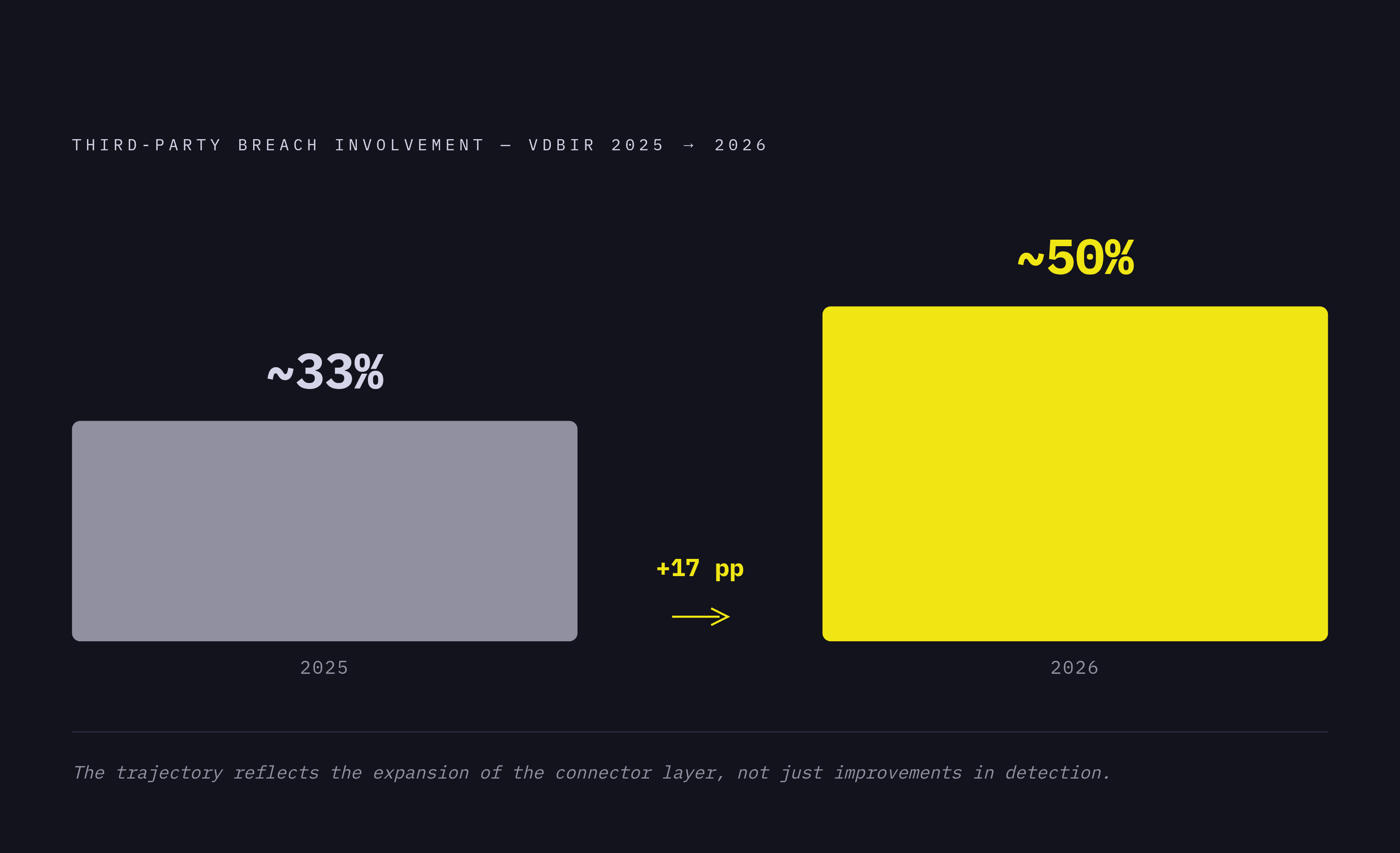
The data shows this is not hypothetical. Verizon's 2025 Data Breach Investigations Report found third parties involved in roughly a third of breaches. The 2026 edition put the figure at nearly half. That trajectory reflects the expansion of the connector layer, not just improvements in detection. Attacker velocity is changing too. The Vercel CEO publicly attributed the attacker's operational speed in the Context.ai incident to AI augmentation. The same technology enterprises are deploying is accelerating adversary tradecraft, compressing the window between initial access and exfiltration.
Why traditional third-party risk management cannot see this exposure
Traditional third-party risk management was designed to assess infrastructure, access controls, and data handling at a point in time. It cannot track the dynamic, multi-hop, non-human data flows that vendor AI connectors create between assessments. The framework simply predates the problem.
Start with the questionnaire gap. Standard TPRM questionnaires do not capture AI-specific exposures. Then there is the timing gap. Annual or periodic audits cannot track connector states that change continuously. The Klue credential was four years old when it was exploited, well past any reasonable audit cycle.
The shadow AI discovery problem makes this worse. AI arrives inside approved SaaS products rather than as separate applications, so it does not appear in software inventories. Discovery is a prerequisite for assessment, and the connector layer systematically defeats the discovery methods TPRM relies on.
Then comes the compliance forcing function. US states are adding AI-specific requirements each quarter. This regulatory demand to map data flows several hops deep into the vendor chain is a requirement most connector procurement processes were not designed to meet.
The usual objection is "we do vendor risk assessments on our AI vendors." The counterargument is that the connector layer means the risk is not primarily in the AI vendor you assessed. A vendor can pass a thorough assessment while the OAuth token it issued six months ago remains a live attack surface in your environment. Promptarmor's continuous monitoring identifies when a connector introduces a fourth-party dependency or when a sub-processor's retention policy shifts mid-deployment, the exact blind spot that snapshot-style assessments leave unguarded.
What a connector-aware risk program actually monitors
Governing the connector layer starts with continuous visibility into live connector states. Which tokens exist, what permissions they carry, what data flows through them, which MCP servers are reachable. The risk is dynamic, and point-in-time assessment misses most of it.
Discovery comes before governance. Mapping all active OAuth grants, MCP configurations, and agentic tool chains across the vendor ecosystem is the prerequisite step. That includes connectors established by individual employees through trial accounts and shadow AI tools, not only those approved through procurement. The urgency here is measurable. Netskope's 2026 AI Report identifies downstream data policy violations, where an AI service returns sensitive data that a user or agent is not authorized to access, as rising sharply alongside a fourfold increase in MCP traffic in the past 10 weeks alone. Usage is scaling faster than inventory.
Permission scope is the primary control variable. The decisive control point in an agentic flow is not what content is scanned but who or what is authorized to move it. NHI Management Group's 2026 analysis frames AI agent exfiltration as an authorization problem before it is a content problem. Practitioners should treat agent authorization as the first line of data loss prevention. That means tool-level permissions and delegated access paths in MCP-connected workflows deserve the same rigor applied to other privileged access routes. They are not productivity settings. Scoping each connector to only the data it needs for the task it performs is the mitigation.
Continuous monitoring of vendor AI assets before and after deployment addresses the timing gap that periodic assessments miss. The credential exploited in a breach may have been issued and forgotten months or years before the attack. A dedicated AI risk intelligence platform does this work: assessing vendor AI assets continuously across the enterprise's vendor ecosystem and surfacing emerging connector-layer threats before they breach compliance thresholds or business continuity. Detecting exfiltration at the connector layer requires identifying anomalies in how data moves through sub-processors, unexpected calls to analytics platforms, unusual data volumes in model provider logs, sudden changes to MCP server permissions. These patterns only emerge when you track vendor AI deployments in real time rather than relying on static risk assessments or annual audits. Generic governance frameworks and traditional TPRM tools were not designed to provide that capability.
Finally, fourth-party sub-processor mapping becomes a compliance deliverable. GDPR ROPA requirements now force organizations to document the LLM provider inside a vendor's product and that provider's own sub-processors. That data-flow mapping exercise can only be completed if the organization knows which connectors exist and what they route data through. The mapping is no longer optional. It is the foundation the regulation now assumes you have.