The AI Risk Intelligence Stack Top-Tier Law Firms Deploy Across Their Vendor Ecosystems
Law firms need layered controls to govern AI vendor risk that procurement checklists cannot address.
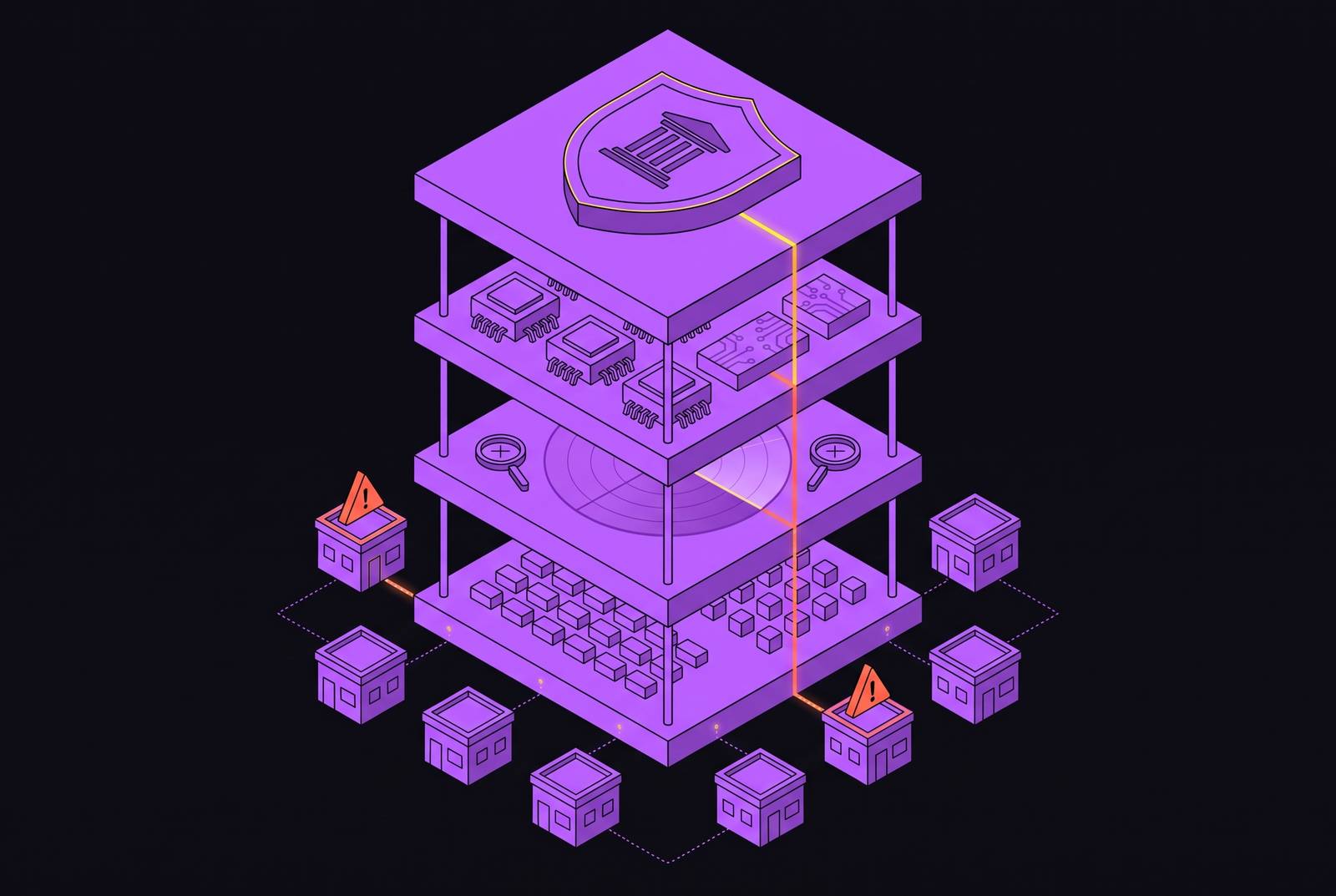
AI-specific third-party risk management requires four connected layers, namely a living inventory, pre-procurement vendor assessment, continuous monitoring, and AI-specific threat detection. For top-tier law firms, this stack tackles a mismatch that standard procurement checklists cannot fix. The firm remains accountable for client confidentiality and professional competence, while vendors control the systems through which those duties must be met.
Why law firms cannot govern AI vendor risk the way they govern other third-party technology
Where does a privileged document go, who can access it, and what persists after AI processing? A firm should be able to answer before allowing a vendor to process that document. Yet the answer may depend on infrastructure and model behavior the vendor cannot or will not explain. Under the SRA’s outcomes-focused framework, competence and confidentiality remain non-delegable. Without that explanation, the firm cannot demonstrate control.
The vendor may not understand how its product behaves in legally sensitive situations, while warranties and indemnities cannot undo a privilege waiver or regulatory breach. Architecture is therefore part of the compliance decision. Harvey AI’s deployment across the majority of the AmLaw 100 shows the scale of the exposure. When IT assesses security, innovation teams assess capability, and practice leaders assess usefulness before risk teams enter the conversation, the procurement process separates decisions that professional accountability requires firms to join.
The five distinct risk categories that make up the AI vendor attack surface in legal practice
Confidentiality and data-flow opacity concern where information travels and how it is used. The ABA has highlighted that an AI vendor may not operate the underlying model itself. A product can relay client material to third-party models without the customer understanding the dependency. The primary contract is not the whole system. To uncover undisclosed processing or training use, firms need to trace data flows as well as assess the named supplier.
Hallucination and professional liability concern the reliability of work counsel submits. Gordon Rees Scully Mansukhani had an individual attorney reprimanded for AI hallucinations in an Alabama bankruptcy court. The firm received an additional reprimand in the December 3, 2025 California federal court case Villalovos-Gutierrez v. Pol. Magistrate Judge Carolyn Delaney wrote that counsel shall not file documents containing AI-hallucinated citations. Responsibility stayed with counsel, regardless of the tool.
Prompt injection and novel attack vectors involve deliberate manipulation. In July 2026, an individual embedded hidden AI instructions in a legal court filing, an act sanctioned in August 2026. The document itself was the attack route. Law firms receive files from opposing counsel, clients, and prospects that AI may legitimately process. Data poisoning and model inversion add different mechanisms, including manipulated inputs and attempts to infer sensitive information from model behavior.
Agentic AI and amplified autonomous risk concern systems that execute tasks as well as generate answers. Firms can see only some of what agents do within vendor infrastructure. Vendor lock-in is a separate dependency risk. Robin AI was listed for a distressed sale on an insolvency marketplace in October 2025 while still operational, and Workday acquired Evisort in September 2024. Beyond stored documents, dependence can encompass playbooks, clause libraries, prompt templates, workflow logic, and audit trails held in vendor-specific formats.
Why generic procurement frameworks and compliance checklists cannot map to this risk surface
Why can't an existing third-party risk questionnaire simply have an AI section added to it? The problem lies in what it assumes. AI systems ingest, transform, infer, and generate, while their underlying models and dependencies can change after approval. A framework built around static software does not establish control over those changing behaviors. A completed questionnaire records an assessment at a particular time.
Client requirements expose that distinction in practice. Outside counsel guidelines commonly call for closed-system processing, review by an attorney, no use of client data for training, and a written statement of how AI is used. At least one large client has specified permitted vendors through a unilateral engagement-letter amendment. No single procurement checklist establishes continuing compliance with those conditions. Once an incompatible architecture has been bought, training can only limit the consequences, so the response must be a connected control system.
Layer one — building a complete and continuously updated inventory of AI assets across the vendor ecosystem
An inventory must capture actual AI use, including capabilities embedded in products the firm did not purchase as AI tools. Licensed software is only the starting point. More than half of legal professionals say their firm either has no AI policy or they are unaware of one, leaving usage decisions without clear guidance. An inventory limited to approved purchases therefore misses part of the exposure. It also needs to identify sub-vendor dependencies, including models behind a contract-review product.
That record must change when the environment changes. Vendors may replace or update AI components between renewals without notifying customers, making a one-time audit inadequate. Without updates, later assessments and monitoring rely on a map that is out of date. The test of completeness is whether the firm can explain the path and persistence of privileged material for every AI system it actually uses.
Layer two — how should firms assess AI vendors before procurement?
Assessment must precede purchase and use criteria specific to AI. Data-flow transparency comes first. Firms should require documented explanations of ingestion, processing, logging, access, and deletion, extending to any third-party model provider. A promise that information is “not used for training” leaves several of those questions unanswered. Limits on secondary use, subcontractor access, cross-border transfers, and keeping data longer than needed should be in terms the firm can enforce, with audit rights to back them up.
Model-level explanations and jurisdictional control test whether the proposed use is compatible with professional duties. Vendors should explain how outputs arise, how errors occur, and how updates are governed. Processing location is part of that assessment. WilmerHale’s published AI vendor framework specifies disclosure of AI features at signing and throughout the contract term, plus notice of material model changes. Exit terms should also provide for extraction, deletion, and independent verification, including portability of the knowledge and workflows that make the system useful.
Standards back up these criteria, but firms still need to ask these questions. ISO 42001 Annex A.10 makes supplier governance a certifiable control, while the NIST AI RMF addresses third-party dependencies across GOVERN 6, MAP 4, and MANAGE 3. Controlled trials put the questions into practice. A&O Shearman began its Harvey deployment with a sandbox, giving a limited number of attorneys access in a ring-fenced environment to identify uses and risks and establish governance protocols. Yet Gordon Rees’s second incident despite a firm-wide AI policy shows why approval and written rules still need ongoing workflow controls.
Layer three — continuous monitoring of deployed AI assets for emerging threats and behavioral drift
A sound assessment describes a system at a particular time. Model updates, infrastructure changes, and newly discovered attacks can invalidate it. Behavioral drift makes this especially difficult. Outputs can change meaningfully after a backend update the customer was not told about, even though the product retains its name and interface. Monitoring must track how deployed systems behave and what they depend on between contract renewals.
The court-filing injection incident illustrates how threat knowledge also changes after procurement. A policy cannot spot a new pattern of attacks. Agentic deployments widen the visibility problem further. A&O Shearman and Harvey launched agentic tools in April 2025 covering antitrust filing analysis, cybersecurity, fund formation, and loan review. When these tools act inside vendor infrastructure, firms need to keep watching what they do beyond the conditions seen in an initial trial.
Linklaters’ dedicated AI team shows how a firm can commit to keeping watch over AI use. The Federal Reserve, FDIC, and OCC’s third-party guidance adopted June 6, 2023 includes ongoing monitoring and termination, with heightened oversight for critical activities. For legal AI, monitoring also supports exit planning by surfacing changes in vendor ownership, model dependencies, or retention practices. Those changes can deepen lock-in before a firm reaches its next renewal.
Layer four — AI-specific threat detection where vendor AI meets client data and legal workflows
A prompt injection can arrive in a court filing, client attachment, or intake form that the system is authorized to read. Perimeter security does not resolve that problem. The malicious element is an instruction within legitimate content. Detection must examine how that content attempts to redirect the AI.
Other attacks require different signals at the same layer. Model inversion seeks sensitive information through model behavior, so detection requires attention to input-output patterns as well as file transfers. Generative output can itself disclose protected information. Data poisoning targets what the model learns from or processes, while a compromised prompt may cause information to be transmitted improperly. With agents, a sequence of individually unremarkable actions may collectively form an attack, making the decision chain relevant as well as the final answer.
For TPRM, InfoSec, Privacy, and Legal teams, the capability requirement is specific. A dedicated AI risk intelligence platform needs to combine vendor assessment with real-time AI threat detection across the vendor ecosystem. Conventional security remains useful, but it is insufficient. Tools focused on network access or file movement cannot substitute for inspection of AI instructions, model behavior, and agent actions.
How the layers interact — why removing any one creates exploitable gaps
A client’s permitted-vendor amendment shows how one requirement crosses the whole stack. The inventory identifies affected tools and dependencies, while assessment establishes whether they meet the restriction. Monitoring then follows changes that could invalidate approval. AI-layer detection addresses non-compliant data flows where processing occurs. Without the inventory, even capable detection may never cover a tool the firm does not know is in use.
The Gordon Rees pattern exposes a different gap. AI-hallucinated citations reached another filing despite a firm-wide policy, showing how little rules can do without reviews that work. Vendor lock-in creates a similar dependency between assessment and monitoring. Negotiated exit rights are harder to exercise confidently if the firm does not know which models, sub-processors, or retention practices have changed. As agentic AI embeds more deeply in vendor products, these connections become harder to maintain through isolated controls because actions, data flows, and supplier dependencies increasingly form one chain.
What firms that have built this stack have done differently at the organizational level
A standing governance function gives the stack authority beyond a procurement project. Linklaters built a 20-person dedicated AI team, giving the firm a team responsible for ongoing oversight. Clifford Chance took a different implementation route. It built Clifford Chance Assist as a private, secured tool on Microsoft’s Azure OpenAI platform after extensive trials with over 1,800 users across practice areas and operational functions. Those trials had the express aim of finding risks as well as testing the user experience.
These examples demonstrate organizational choices. The shared principle is accountable decision-making. IT and legal operations need help to settle questions of professional risk, and a policy needs someone responsible for it to govern vendor systems as they change. General counsel engagement brings sanctions and malpractice exposure into sourcing decisions, changing the question from whether a tool improves efficiency to whether its use can withstand scrutiny. For firms without this model, the starting point is a standing function with defined authority and a living inventory, followed by assessment and operational controls connected to actual use.
The external pressures making the layered stack increasingly non-optional for top-tier firms
Client mandates turn governance into a condition of access to work. A firm must be able to demonstrate that its processing, review, disclosure, and vendor choices meet the engagement’s restrictions. Written policy alone cannot establish that evidence. Professional duties and supplier-governance standards ask more of firms, while the vendor distress and consolidation already described make portability a useful safeguard. Competitive adoption therefore depends not just on obtaining capable tools, but on retaining control as those tools and their owners change.
These pressures favor building the stack before an incident. Once a deployment has created uncontrolled processing or entrenched dependence, downstream training cannot reconstruct the protections missing at purchase. The firm still answers for the outcome. Technical control, meanwhile, remains distributed across vendors, models, and embedded agents. No single tool or policy resolves that asymmetry, but a connected inventory, assessment, monitoring, and detection stack gives the firm a way to govern it as AI reaches further into legal work.