Adversarial Query Pattern Detection Across Vendor LLM API Integrations
Vendors change models secretly; gateways alone cannot stop indirect injection.
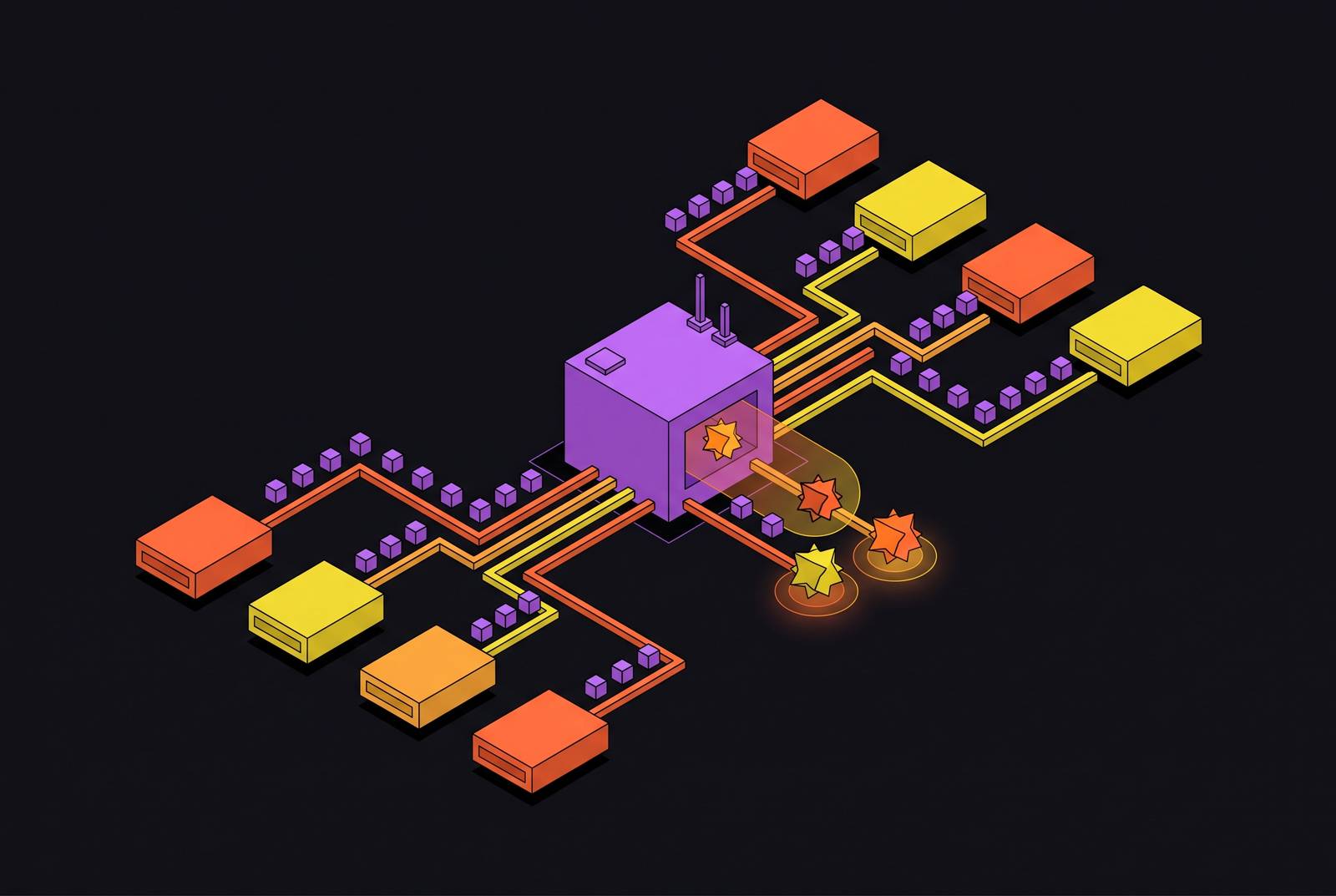
Detecting attempts to extract system prompts or exfiltrate data through vendor LLM APIs requires layered monitoring of user queries, retrieved content, conversation history, model outputs, and tool calls. Adversarial query pattern detection must also test vendor behavior, because an opaque API can change what it serves. Gateway filtering is still needed, but keeping instructions and data confidential takes checks across the full integration stack.
Why multi-vendor LLM API integration creates an adversarial surface that single-point defenses cannot see
A model connected to other models, retrieval systems, and tools sits inside a chain of delegated access. Its response may become another agent’s context or determine which API a tool calls next. That changes the scope of an injection attempt. If an integration layer such as Model Context Protocol trusts model output too much, manipulated context can become an unauthorized API call, data exposure, or workflow abuse.
The underlying weakness is a blurred boundary between instructions and information. Models handle trusted system instructions and untrusted user input through the same text-based interface, which does not reliably keep control data separate from source data. An assertion of authority can therefore arrive as ordinary prose. In retrieval-augmented generation, that prose may come from an email, document, or web page.
What, then, counts as the input boundary? The original user query is only one entry point, because every retrieved document can introduce instructions later in the workflow. Zhu et al. at ICLR 2026 explain that API users usually have no model weights and, in most cases, no output logits, which makes it harder to tell which model they receive. The resulting attack surface is an emergent property of how the system is assembled.
How adversarial query patterns manifest architecturally across the vendor API surface
Direct prompt injection comes through the conversation with the user. An attacker tries to override system instructions or hijack the model’s role by asserting a new identity or authority in plain text. OWASP treats jailbreaking as a subtype of prompt injection. For system prompt confidentiality, the relevant question is whether that attempted redirection seeks disclosure of instructions that the application intended to keep confidential.
Indirect injection comes through material the model fetches. An attacker can put instructions in uploaded files, database records, emails, or web pages without having direct access to the conversation. Retrieval becomes the delivery path. The CISPA Helmholtz Center study published in April 2026 found thousands of validated injection instances, with a small set of reused templates accounting for the overwhelming majority. Forcepoint independently observed shared templates across domains, including payloads that appear to act as probes for systems vulnerable to accessibility-layer injections.
Agent-specific injection targets the next action by redirecting API selection, tool-call arguments, or a multi-step workflow. The request record can obscure this manipulation. A study described at IEEE S&P 2026 looked at thousands of websites and seventeen third-party plugins and found vulnerabilities that involved privileged roles and scraped content. It also found that plugins logged original starter messages even when attackers omitted or overwrote them, while leaving out all system messages, whether original or forged.
Other patterns cut across these entry points. Multimodal injection places instructions in images or audio, while Base64, Unicode substitutions, and token-split payloads seek to evade pattern-based filters. Multi-turn attacks spread the redirection across the conversation history. No single turn contains the whole attempt. These distinctions form a detection map, because a text filter, a conversation-level detector, and a tool-call control observe different parts of the attack.
Why the vendor's black box is itself an adversarial variable, not just a passive medium
Even if the application recognizes hostile queries, is the API still serving the model whose behavior the enterprise evaluated? Procurement does not settle that question permanently. An opaque provider could substitute, quantize, or fine-tune a model, changing its performance and safety properties without the client’s knowledge. This is a threat model for opaque APIs.
Zhu et al. formalize the possibility that providers change served models to reduce costs or maliciously alter behavior. The audit itself can become recognizable traffic. A dishonest provider could spot query distributions built for testing and send those requests to the authentic model, while serving something else for ordinary use. Mixing responses from multiple models can make the resulting distribution harder to distinguish from the expected one.
Wu et al.’s Ventor-QTest, published on arXiv in August 2026, uses a two-sample model equality test to check vendors across five classes of provider behavior that grow increasingly adversarial. Gao et al.’s prior Model Equality Testing work reports distributional inconsistencies among commercial Llama endpoints. These findings leave room for differences in behavior that do not show deception. The distinction is important for interpreting an audit. Behavioral testing concerns what an endpoint serves, while attributing intent is a separate claim.
The lesson for audit design is to avoid a testing pattern that a provider can recognize and selectively answer. Zhu et al.’s rank-based uniformity test, or RUT, compares a black-box API with a locally deployed authentic model while avoiding detectable query patterns. This changes what the control is testing. Rather than asking whether a particular prompt is malicious, it asks whether the vendor’s behavior matches the reference on which the enterprise’s assessment depends.
Why input filtering at the API gateway is necessary but structurally insufficient as the primary control
Gateway filtering can reject suspicious user input early. It can catch attacks represented in a detector’s training data and reduce the hostile traffic reaching the model. That is a necessary security layer. Adaptive attackers can design payloads to evade the detector, and OWASP’s position as of 2026 is that no known engineering fix definitively eliminates prompt injection.
Increasing sensitivity does not remove that limitation. Aggressive guardrails can block legitimate requests, turning detection into a trade-off between missed attacks and disrupted use. Vendor differences complicate the trade-off further. Detection signals do not transfer cleanly across traffic distributions, so a classifier tuned to one endpoint may fail to recognize attacks arriving through another.
More fundamentally, some attacks never cross the gateway in the form it inspects. A benign user query can trigger retrieval of a document containing hidden instructions after the original query has passed screening. Each turn may look acceptable alone, while the accumulated context redirects the model. Neither gap is solved simply by making the original user-query filter stricter.
Tool calls expose the clearest limit of gateway-only protection. Their arguments are outputs generated after the gateway has examined the user inputs. A response classifier that records a violation after an unauthorized call executes is too late to prevent that action. Timing is part of the control’s function. For system prompt confidentiality and data exfiltration risk detection, the primary control cannot sit only before retrieval, generation, and delegated action have occurred.
How do you detect system prompt extraction and data exfiltration across the full integration stack?
At the pre-processing layer, semantic analysis addresses attacks that evade surface patterns. Fang et al.’s Adversarial Prompt Disentanglement framework, presented at AAAI 2026, separates adversarial and benign prompt components using mutual information-based semantic decomposition. It combines that separation with graph-based intent classification, spectral analysis, and a lightweight transformer-based classifier. Meaning becomes the detection target, rather than spelling alone. Its evaluations report reduced harmful output generation with negligible impact on model performance and a computational profile suited to real-time deployment.
Inside the model, PIShield, introduced in October 2025, uses residual-stream representations and a simple linear classifier to find injected instructions without having to generate a response or fine-tune the model. This provides a signal distinct from external text inspection. Access is the practical constraint for vendor integrations. Activation probes are model-specific and do not transfer across architectures, so this approach requires internal visibility and a trained probe for each model rather than offering a universal detector for opaque APIs.
Conversation-level probing tracks internal signals as the conversation moves from turn to turn. Research on multi-turn activation probing in 2026 found that scalar trajectory features improved conversation-level detection on synthetic held-out data, with the signal replicating across multiple model families. The evaluation setting limits the claim’s reach. It supports monitoring the trajectory of a conversation, but does not establish universal production performance. Per-model probe training remains necessary.
At the output boundary, controls address what the application is about to disclose. For protecting confidential system instructions, the relevant control is interception of disclosure or other goal-drift responses before they leave that boundary. Tool execution needs a separate interception point. Inspecting arguments before execution addresses unauthorized actions that response-only screening cannot stop, including actions that could expose data through connected APIs.
At the vendor boundary, RUT addresses behavioral equality. Its local authentic-model requirement distinguishes it from both output screening and ordinary hosted API monitoring. These are complementary methods. PIShield concerns internal injection signals, APD concerns semantic pre-processing, and RUT concerns the served model’s behavior.
Ongoing adversarial testing gives those layers fresh inputs to use in detection. Praetorian’s Augustus, released in February 2026, supports automated prompt injection and jailbreak testing across twenty-eight LLM providers. Red-team results can feed classifiers and policy rules, while the distributions seen in production call for more tests after procurement. Logs of prompts, completions, tool calls, and token usage provide the raw material for finding unusual patterns and reconstructing what happened.
What continuous monitoring across vendor AI assets requires in practice, and where dedicated platforms fit
Ongoing monitoring treats each vendor model as having its own behavior. Its activation probes may need their own training, its traffic may be hard for existing classifiers to handle, and its behavior may change after the first assessment. Integration components require equal attention. Plugins, MCP connectors, and tool-call handlers determine how model output becomes action, so monitoring only the enterprise’s own model deployment leaves part of the access chain unobserved.
Operational visibility must extend across every vendor endpoint, including prompts, completions, tool calls, and token usage. Immutable audit trails help teams look into incidents and keep the records that rules require, including those under the EU AI Act and GDPR. Completeness comes before an audit-ready label. The plugin study’s missing and misleading message records show why a log of the starter prompt is not necessarily a record of the request sent to the provider.
Detection also needs renewal as attack tooling changes. The CISPA study’s concentration of reused templates suggests that organized campaigns can spread common payloads widely, while new campaigns can introduce patterns existing classifiers do not recognize. Monitoring is therefore an ongoing discipline. Vendor behavioral auditing, integration assessment, and adversarial testing each contribute evidence that a point-in-time review cannot supply.
Traditional tools cover only parts of that discipline. Classical web application firewalls and API gateways check HTTP structure but do not check the prompt semantics, generated tool arguments, or model drift discussed here. Generic third-party risk management frameworks assess vendors at a point in time. OWASP’s LLM Top 10 and NIST AI 600-1 provide risk categories, but they are not production monitoring systems. A framework can identify what deserves assessment without detecting when its state changes.
A dedicated AI risk intelligence platform fits where those separate responsibilities need continuous, ecosystem-wide coverage. Its purpose is to combine vendor risk assessment with ongoing behavioral monitoring and real-time AI threat detection across APIs, plugins, agents, and connectors. Coverage is the meaningful selection criterion here. For TPRM, InfoSec, Privacy, and Legal teams, especially in large enterprises and law firms using many opaque APIs, the platform must address vendor auditing, cross-vendor visibility, and changes between assessments. The monitoring obligation continues wherever confidential context can become a response or an action.
Sources
- Auditing Black-Box LLM APIs with a Rank-Based Uniformity Test
- Disentangling Adversarial Prompts: A Semantic-Graph Defense for Robust LLM Security
- Auditing Black-Box LLM APIs with a Rank-Based ...
- Accepted to IEEE Symposium on Security and Privacy 2026 When AI Meets the Web: Prompt Injection Risks in Third-Party AI Chatbot Plugins