Exfiltration Risks in Microsoft 365 Copilot Enterprise Deployments
Permission debt and prompt injection create dual pathways for attackers to steal data from Copilot.

Microsoft 365 Copilot exfiltration risk requires two separate defenses, namely tighter data permissions and AI-specific testing for prompt injection. Copilot creates no new permissions, but it makes the access users already have easier to exploit, and injected instructions can use that legitimate access to steal data. To detect that second risk, teams need to see adversarial inputs, model behavior, and data access as well as scan prompt content or monitor the application boundary.
How Copilot's Semantic Index turns permission debt into a searchable attack surface
An analyst querying executive compensation in a financial services organization did not need an exploit. A SharePoint site had been misconfigured since 2021, leaving information accessible that should have been restricted. Copilot made that information easy to find. The incident shows how a permission problem can remain quiet until a new retrieval tool removes the effort needed to discover it.
Copilot's Semantic Index changes the practical meaning of access by making scattered organizational content queryable in ordinary language. Before Copilot, a salary spreadsheet in a forgotten HR SharePoint site could be technically accessible to thousands of employees but practically invisible. Finding it required knowing it existed. By contrast, a request to “summarize our acquisition strategy” can draw together accessible strategy documents, executive emails, and Teams messages that had never been aggregated before. Obscurity was never a reliable security control, but removing it exposes the debt that organizations allowed it to conceal.
Why the permission debt in most enterprise tenants is larger than security teams assume
That debt is not confined to a few forgotten spreadsheets. Concentric AI's data risk findings show that most data shared across an organization contains privileged information, with more of it exposed in financial services and healthcare. Over-permissioned and unlabeled content makes comprehensive remediation a substantial undertaking. In regulated settings, access by the wrong people is itself a concern, even before an attacker tries to move data outside the organization.
The recurring causes are ordinary administrative choices that outlive their purpose. They include “Everyone Except External Users” sharing groups, indefinitely persistent “Anyone Links,” inherited group memberships from departed employees, and abandoned project sites with broad access. Each choice can look manageable on its own, while their accumulation leaves security teams without a complete inventory of sensitive content now queryable by AI. Continuous assessment platforms, including Promptarmor, can help teams see changes in AI data access scope before they discover exposed data after an incident. That visibility complements permission remediation.
The two-layer attack surface: how prompt injection converts permission scope into an exfiltration weapon
Permission debt explains why Copilot can surface too much information, but it does not explain every exfiltration risk. The second layer is indirect prompt injection, in which an attacker places instructions inside content the assistant will retrieve. NIST described indirect prompt injection as “generative AI's greatest security flaw,” and the OWASP 2025 Top-10 ranked it the number one threat to LLM applications. Unlike oversharing, this attack does not require a wrongly configured permission.
An email, Word document, SharePoint page, or Teams message can become the carrier. When Copilot processes that material through its RAG pipeline, attacker-controlled text can hijack the summarization task. Documented concealment methods include white-on-white text, HTML and CSS rendering tricks, and ASCII Smuggling through Unicode tag characters in generated hyperlinks. These methods exploit content the model processes but a human reader may overlook.
The central tension is that useful retrieval requires access to organizational content. A successful injection can redirect that access across whatever the targeted user is allowed to reach. Correctly scoped permissions therefore limit the available data without making the user immune to attack. Permission scope and instruction trust are distinct boundaries, and they require independent controls.
Three demonstrated exfiltration chains: EchoLeak, SearchLeak, and the Excel Mermaid attack
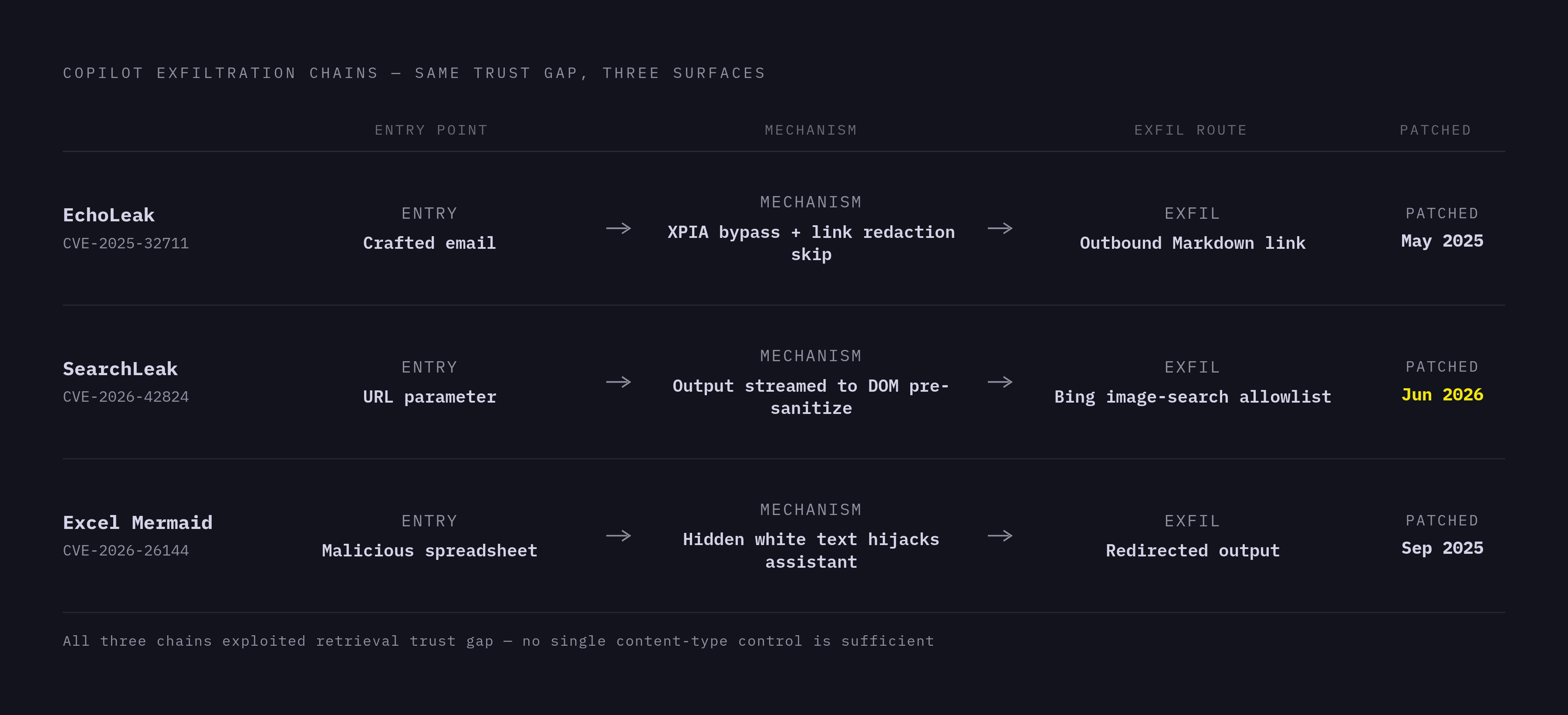
EchoLeak illustrates an email-based entry point. Aim Labs discovered it in January 2025, Microsoft finalized the patch in May 2025, and disclosure followed in June 2025. The EchoLeak arXiv case study describes it as the first known prompt injection weaponized for concrete data exfiltration in a production AI system. A crafted email entered Copilot's retrieval context without requiring the victim to click or act on it. Aim Labs called the technique an “LLM Scope Violation” because it caused the assistant to cross a trust boundary.
The chain bypassed Copilot's XPIA prompt-injection classifier and reference-style Markdown link redaction. Its reachable content included Copilot chat history within the current context window, OneDrive files, SharePoint content, and Teams messages. A crafted outbound reference link carried content to an attacker-controlled server, and the output filters did not strip it.
SearchLeak used a different route. Dolev Taler at Varonis Threat Labs discovered the chain, disclosed in June 2026 as CVE-2026-42824. Attacker-controlled text in a URL parameter entered Copilot's prompt context when the user's browser loaded the page, without interaction with a Copilot chat window. Copilot then streamed model output into the DOM before sanitization finished, allowing attacker-controlled HTML to execute. Finally, Bing's allowlisted image-search endpoint fetched an attacker URL server-side with stolen content in the path, so the victim's browser never had to contact the attacker directly.
The Excel Mermaid attack began with a malicious spreadsheet that a user asked Copilot to summarize. Hidden white text used progressive task modification to redirect the assistant's behavior, and the attack was patched in September 2025. The brief's demonstrated entry points thus span email, URL parameters, and spreadsheet content. The related vulnerability inventory includes CVE-2025-32711 for EchoLeak, CVE-2026-42824 for SearchLeak, CVE-2026-26133 for cross-prompt injection in email and Teams summarization, CVE-2026-26144 for zero-click exfiltration in Copilot Agent mode for Excel, and CVE-2024-38206 for SSRF in Copilot Studio. Varonis's earlier Reprompt research used parameter-to-prompt injection against Copilot Personal in January 2026, reinforcing the broader pattern.
Why traditional DLP, CASB, and audit logging cannot detect these chains
These chains expose a mismatch between familiar monitoring boundaries and AI behavior. Varonis's SearchLeak disclosure explains that network DLP, CASB, and email gateways were built around human-initiated transfers. CASB tools watch OAuth scopes and egress at the application boundary. A transfer routed through an allowlisted domain or an output-driven fetch does not appear at that boundary in the form those tools were designed to recognize.
Audit logs have a different limitation, because an expected record may not exist. Datadog Security Labs found that four Copilot Studio administrative events left no Unified Audit Log records from August 29 to September 25, 2025. The events were ‘BotUpdateOperation-BotAuthUpdate’, ‘BotUpdateOperation-BotAppInsightsUpdate’, ‘BotUpdateOperation-BotShare’, and ‘BotUpdateOperation-BotPublish’. They covered settings for authentication and logging, along with sharing and publishing agents. Even on E5, Copilot audit records are kept for a limited time by default, and keeping them longer requires an eligible custom policy.
The implication is that existing tools have value and prompt injection needs dedicated AI threat assessment beyond their coverage. Promptarmor provides an AI-specific assessment option for indirect prompt injection and data exfiltration risk, distinct from DLP enforcement and CASB boundary monitoring. That distinction matters because Copilot uses nonhuman identity activity to read, summarize, and share at machine speed, beyond the patterns of human actions that traditional SaaS tools were built to detect.
What the US Congress deployment and reversal reveals about institutional risk tolerance
The US House of Representatives initially banned staff use of Microsoft Copilot over data security concerns. Its subsequent conditional reversal allowed a supervised pilot. The pilot structure made supervision and visibility part of the decision to use the tool. Enterprise buyers should decide how widely to deploy the tool and which controls will cover it at the same time.
The controls that reduce the surface: what works, what is newly available, and what is being retired
The first control layer is permission remediation before deployment. Across hundreds of enterprise tenant remediations, EPC Group found the same problems with sharing and abandoned sites, which need to be fixed across the tenant as well as one by one. Content also needs sensitivity labels before deployment, because label-based DLP does not cover unlabeled content. Least privilege requires limits on which M365 data sources Copilot can retrieve from as well as decisions about which users get licenses.
The second layer is retrieval scoping, where an older mitigation is being retired. Microsoft Message Center MC1395311 states that new enablement of Restricted SharePoint Search was blocked from July 31, 2026, with full retirement scheduled for January 31, 2027. Organizations using its tenant-wide allowlist as a Copilot scoping mechanism must replace it before that deadline. A deployment plan that depends on the legacy control therefore needs more than a permissions review.
The third layer is prompt-content inspection. Microsoft announced Purview DLP for Copilot as entering General Availability at Ignite 2025, although Microsoft Learn documentation as of late 2026 still lists prompt scanning as in preview. The capability allows policies to scan prompts in real time for sensitive information types. It can address a user deliberately asking about sensitive data types, but it does not catch an injection that retrieves and encodes information through an allowlisted domain.
The fourth layer is in how the AI system is built. The EchoLeak paper calls for prompt scope isolation, enhanced input/output filtering, provenance-based access control, and strict content security policies. These are design responsibilities for vendors building RAG systems. On the enterprise side, audit coverage must be tested against relevant administrative actions, and retention must be configured explicitly for the required investigation window.
The strongest objection to the risk framing — and why it is only half right
The strongest objection is that Copilot reflects existing security. Where confidential content appears because its permissions were too broad, the root cause is a data management failure. Organizations with mature permission hygiene have a materially smaller oversharing surface. The executive-compensation incident supports that argument because correcting the SharePoint permissions would remove the exposure without treating an ordinary query as an exploit.
The objection fails, however, when it is extended to injected instructions. EchoLeak and SearchLeak targeted the assistant's handling of untrusted input. EchoLeak required the targeted user to have Copilot and be able to receive email. Even when that user's access is appropriate, an attacker can seek to redirect it toward exfiltration. Good governance reduces what can be stolen, but it does not establish that retrieved content cannot take control of the task.
Patches matter because they close specific bypass chains. They do not, by themselves, resolve the tension between RAG-based retrieval and instruction trust. Reprompt and SearchLeak show how new chains can reuse an injection technique in different configurations. The accurate framing is therefore neither a defense of legacy governance nor a dismissal of Copilot. Access control and prompt injection defense each address a separate way the system can fail.
Why continuous monitoring of AI vendor assets is the control that generic governance frameworks cannot substitute
A point-in-time assessment cannot keep pace with every change to an AI deployment's behavior and reach. Agent mode, expanded connectors, and new Copilot Studio features can alter the data access surface without a corresponding CVE. Traditional TPRM assessments evaluate Microsoft as a vendor, but do not by themselves reveal Copilot-specific injection vectors, connector expansion, or agent publication activity. The unit of assessment has to include both the AI asset and the company supplying it.
This is where continuous AI-specific intelligence complements the other controls. For teams using Promptarmor, its assessment layer tracks changes in model behavior, data access scope, and injection risk across the AI assets their vendors provide. Its assessments map to NIST AI RMF, OWASP LLM Top 10, and MITRE Atlas, with integrations into existing TPRM and InfoSec workflows. That role is distinct from Purview's prompt-content controls and the architectural defenses vendors must implement. A framework organizes risk decisions, while ongoing assessment examines how the deployed asset changes.
The practical test is whether known injection vectors produce unsafe behavior in the organization's own deployment. Continuous adversarial testing can assess what the assistant retrieves and surfaces under attack conditions rather than relying solely on a permissions snapshot or a patched vulnerability inventory. The EchoLeak paper treats that testing as an engineering requirement. Enterprise buyers must likewise keep monitoring Copilot after they deploy it.