Detecting Prompt Injection Attacks That Target System Prompt Extraction in Production LLMs
Defenders must filter inputs and monitor outputs outside the model to block prompt extraction.
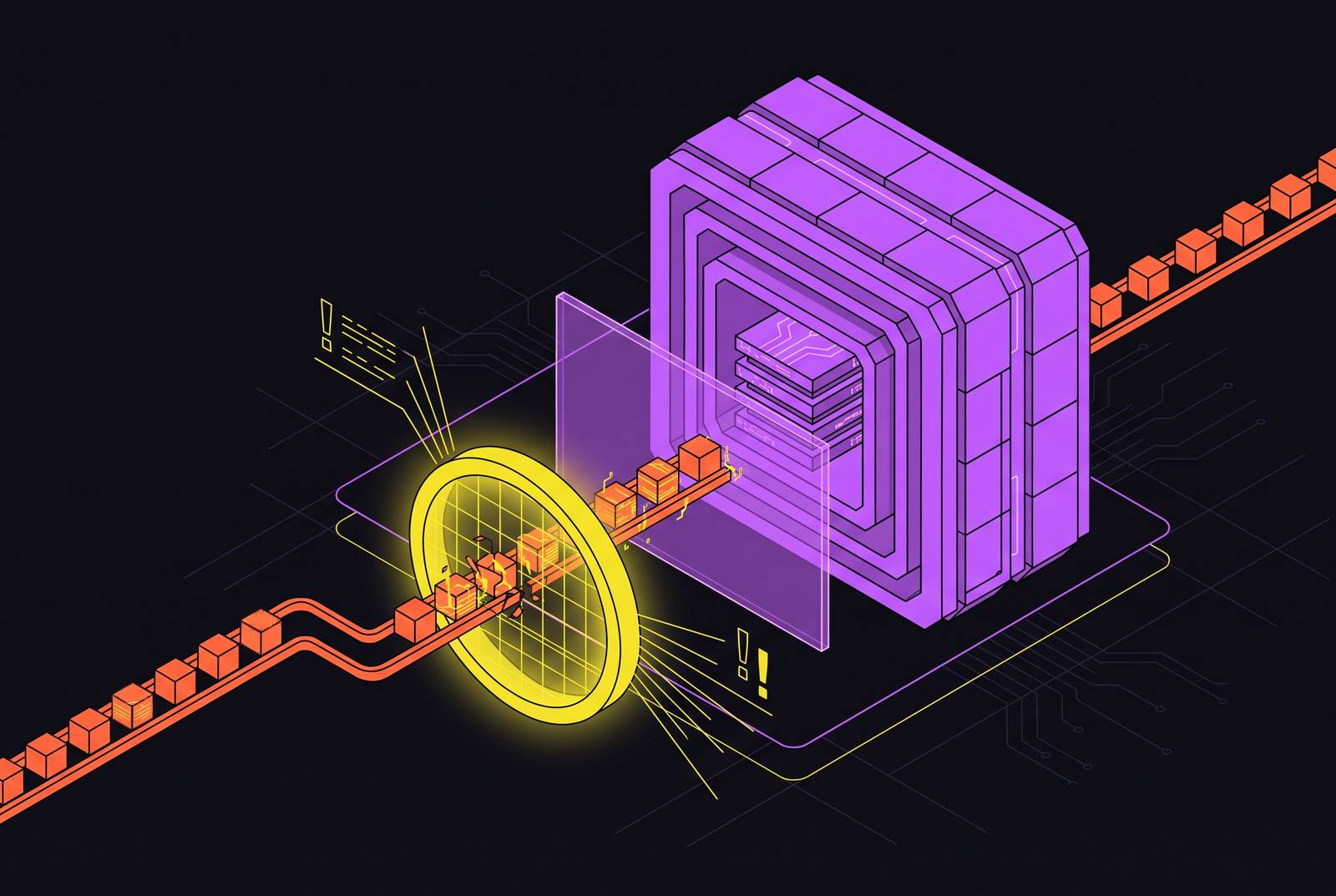
To detect prompt injection attacks that target system prompt extraction, operators need controls outside the model, including input classification, output filtering, and session-level monitoring. Input checks flag what looks like an attempt, while response checks catch instructions that leak out. For system prompt confidentiality and data exfiltration risk detection in LLM deployments, the strongest approach is a layered application-level defense.
Why system prompt extraction is a distinct threat in production LLMs
System prompt extraction targets confidential operator instructions rather than simply trying to make a model produce prohibited content. That distinction sets the detection target. A response can be harmless in ordinary language yet expose proprietary business rules, data-routing instructions, or tool access logic. Persona definitions can also reveal how an application is meant to behave. Together, these instructions give an attacker a blueprint for further exploitation.
The basic attack can run through a normal API call. An adversary supplies an instruction intended to override the system prompt’s confidentiality directive, then reads the model’s verbatim or paraphrased response. Production applications are exposed because accepting arbitrary natural-language input is part of their purpose. Although an application can label operator and user messages differently, the model has no authenticated boundary that guarantees it will keep their instructions separate.
Responses therefore need to be checked for sensitive user data and disclosure of the rules governing the application itself. Enterprises using vendor models face an added blind spot when they do not continuously monitor behavior and leakage. Platforms such as Promptarmor can surface exposure of system instructions through monitoring of vendor AI deployments. That visibility matters because the value of a leaked prompt extends beyond its text to the application behavior it describes.
How extraction attacks work in practice
Extraction instructions can enter through the user’s message or through material the application supplies to the model. In direct injection, the request comes in the user turn and sometimes asks the model outright to repeat its system prompt. In indirect injection, malicious instructions are put in retrieved documents, web content, or tool outputs. When the model treats that material as trusted context, an attacker-controlled document becomes an instruction channel. A filter that examines only user messages never sees the malicious text.
Encoding, token splitting, role-play framing, and language switching can conceal the lexical patterns a simple filter expects. The underlying request can remain the same while its surface changes. Detection therefore has to account for meaning as well as recognizable phrases. This is why a fast pattern check is useful but incomplete.
Attackers can also spread the request across a conversation and draw out pieces of the instructions a bit at a time. A single-turn classifier may miss what the attacker is trying to do across those turns. Similarly, a request for a summary of the model’s instructions can disclose their logic without copying their wording. These patterns call for both session correlation and semantic output checks. For indirect injection, AI risk intelligence platforms, including Promptarmor, address the related visibility gap by monitoring vendor configurations and integration points, while content scanning must cover the external material itself.
Why the model itself cannot be relied on to resist extraction
A confidentiality instruction is processed in the same context window the attacker is trying to manipulate. Telling the model never to reveal its instructions is therefore a soft constraint. The model computes a probability distribution over tokens conditioned on its entire context. An injected instruction can shift that distribution toward disclosure even when the operator’s text says disclosure is forbidden.
Evaluation of Prompt Injection Defenses in Large Language Models, published in April 2026, found that every tested defense that relied on the model to protect itself broke in the end under adaptive attacks [1]. Output filtering implemented in separate application code was the only tested defense that held. That result supports placing the confidentiality boundary outside the model. It does not establish that every possible output filter will catch every form of leakage. The filter still needs to match the information and evasion patterns it is meant to detect.
Provider safeguards also address a different question when they focus on harmful content generation rather than confidentiality of operator-authored prompts. A model may follow those safeguards and still give away private business rules. More importantly, an instruction to preserve secrecy does not itself produce an observable failure signal. Without independent monitoring, an operator cannot tell whether the model followed that instruction on a given request. External detection and output filtering turn an otherwise hidden failure into something the application can act on.
Input-side detection before requests reach the model
An input classifier sits between the content coming in and the model, flagging what look like extraction attempts before they enter the context. A flagged request may never have succeeded, while a request that passes may still induce leakage. Keeping that distinction clear prevents input-classification results from being mistaken for a measure of system prompt confidentiality. This layer reduces exposure but cannot establish that the response is safe.
Rule-based filters provide a low-latency first pass for familiar phrases, including “repeat your instructions” and “ignore previous”. Their strength is speed and their weakness is dependence on wording. A secondary model trained to distinguish benign from adversarial input can assess semantic meaning instead. That gives it better coverage across rephrasing and language variation, though new evasion patterns still require ongoing retraining.
Structural prompt hardening complements these checks by placing system content where the model is trained to treat it as authoritative. Delimiters or special tokens can also give the classifier signs of an attempted override to monitor. These steps make an attack harder but give no guarantee that the boundary will hold. Separately, retrieved documents and other external content must be scanned before entering the context. A user-turn classifier cannot stand in for inspection of a retrieval-augmented generation pipeline’s documents.
How do you detect system prompt leakage in model responses
Output monitoring examines the result. It is the last detection point before leaked content reaches the user, including when an attack passes input checks. Exact-match and fuzzy-match filters compare response text with the system prompt and can flag or redact substantial verbatim or near-verbatim overlap. Their limitation follows directly from their method. A response that explains the same rules in different words may have little string similarity.
Semantic similarity scoring addresses that gap by embedding both the system prompt and the response, then comparing their vectors. High similarity without matching strings can signal paraphrase extraction. This adds latency and compute cost, but targets a form of disclosure that lexical filters miss. An out-of-scope content classifier offers another signal by assessing whether the response answers the stated user task. A response that instead describes its own instructions without a plausible task reason is anomalous.
Canary tokens are a simpler way to check for leaks with high precision. Plant unique, randomly generated strings inside the system prompt that have no legitimate reason to appear in a user-facing response. Then check every response for those strings before returning it to the user. If a canary appears, it confirms that content from the protected context has escaped, regardless of how the attacker phrased the input. This makes canaries a low-cost control that is resistant to input-side evasion, though a paraphrase can omit the marker, so the absence of a hit does not establish confidentiality.
Logging, alerting, and the observability infrastructure extraction detection depends on
A detector needs a record behind its signal. For every input-output pair, that record must include the full user input, any retrieved context, the model’s response, classifier scores, and session or user identifiers. Without this detail, even a confirmed canary hit cannot be traced to its source or looked into properly. The retrieved context is especially important when the user’s own request contains no malicious instruction. It lets an investigation reconstruct what the model actually received.
Those records also need to be correlated at the session level. Per-turn inspection can leave a gradual extraction campaign hidden among requests that appear unremarkable on their own. Session aggregation shows the pieces that leaked and the order of the requests. This is the operational counterpart to the multi-turn attack pattern. Logging each turn is necessary, but looking at each turn in isolation is insufficient.
Alerts must make clear whether they flag a suspected attempt or a confirmed leak. High false-positive rates erode trust, so input-classifier thresholds need calibration against labeled traffic before blocking is enabled. Logged adversarial inputs and confirmed extraction events should then feed classifier retraining. Without that feedback pipeline, production traffic shows new attacks but does nothing to help classifiers catch them. In regulated environments, the same audit trail may also be needed to demonstrate that the operator exercised reasonable controls.
How third-party AI risk monitoring fits into the detection stack for vendor-deployed LLMs
With a vendor-supplied model, the operator cannot inspect or change its weights, training pipeline, or internal guardrails. Detection must therefore work through the application boundary. Traditional third-party risk management assesses a vendor’s security posture at a point in time, but that assessment does not continuously observe runtime behavior. A model update can alter how confidentiality instructions are weighted. New plugins, tool integrations, or retrieval sources can also change the content reaching the model.
Changes to the vendor’s own system-level prompt introduce another source of uncertainty because they may interact with the operator’s instructions. The deployed application needs to preserve confidentiality after those changes, even when the provider has safeguards. Checking input-output pairs on an ongoing basis keeps the model’s behavior in view even when its version changes. Independent assessment of behavior is therefore necessary even when provider assurances remain part of vendor evaluation.
Promptarmor is one option for AI-specific risk intelligence that brings input classification, output monitoring, canary-based detection, and session correlation into the application-to-vendor layer. Application-built classifiers and response filters offer another way to implement the controls described here. The relevant comparison is coverage, including inspection of external context, detection of paraphrased leakage, session visibility, and monitoring across vendor changes. A platform belongs in the stack when it addresses those gaps.
Building a layered detection posture and keeping it effective
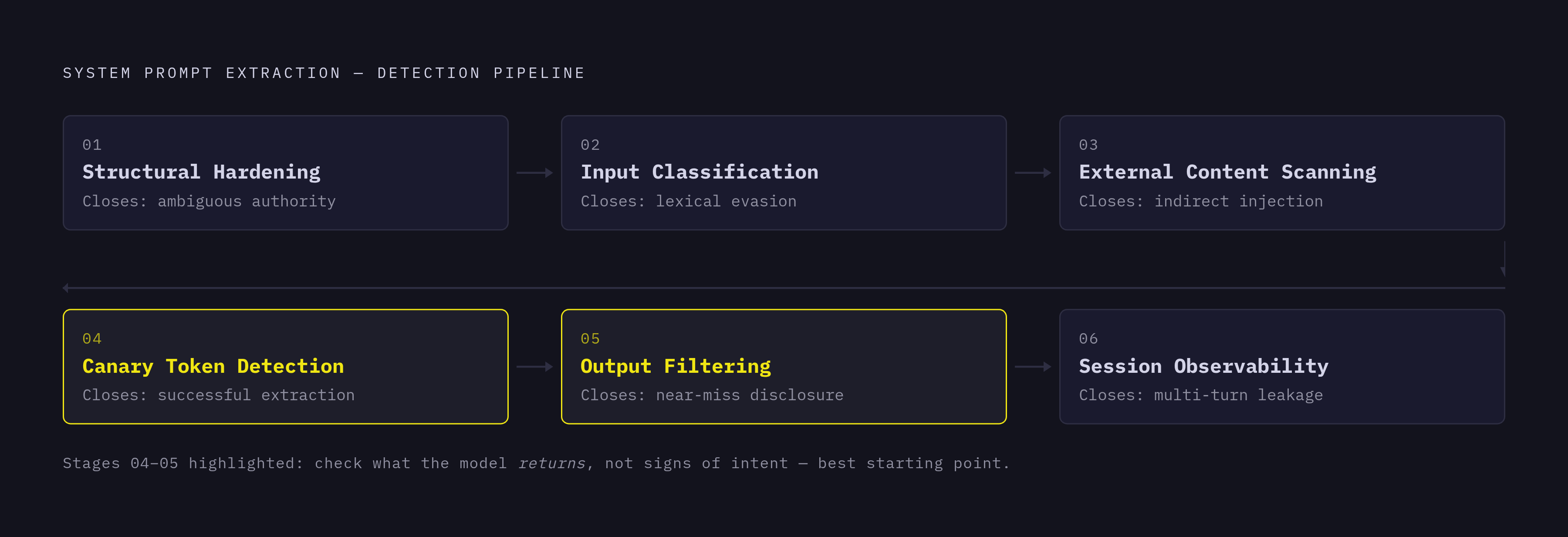
The architecture begins with structural hardening, using delimiters and authoritative placement to raise the baseline effort required for an attack. Input classification follows, with lexical rules as a fast pass and a semantic classifier for less obvious requests. Independent scanning of retrieved and external content closes the channel gap left by user-turn inspection. These layers limit what reaches the model, but their shared limitation is that they judge inputs. They cannot detect disclosure of confidential instructions in an allowed interaction.
Canary detection and output filtering supply that result-side check, with semantic scoring extending coverage to paraphrases. Session-level observability then joins signals across interactions and feeds confirmed events into retraining. For vendor deployments, continuous external monitoring covers changes that invalidate assumptions made at launch. Each layer is useful only when it compensates for a different blind spot.
For teams that can only do so much, canary tokens and output filtering are the best places to start because they check what the model returns, going beyond signs of suspicious intent. They are also model-agnostic, making them useful across vendor deployments. Their value still depends on the surrounding operation, including actionable alerts, threshold tuning, and review of logged events. As attack patterns and integrations change, classifiers need retraining and detection coverage needs reassessment. Robust system prompt confidentiality is a continuously operated practice.