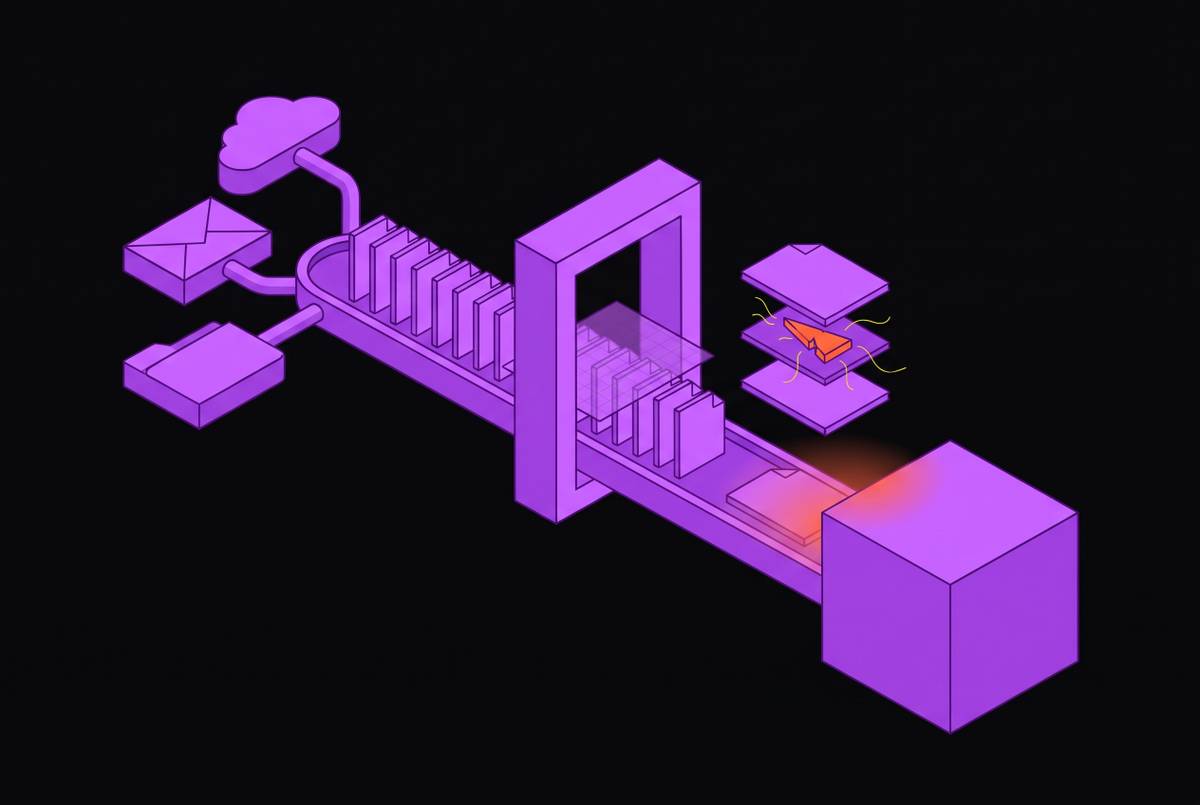
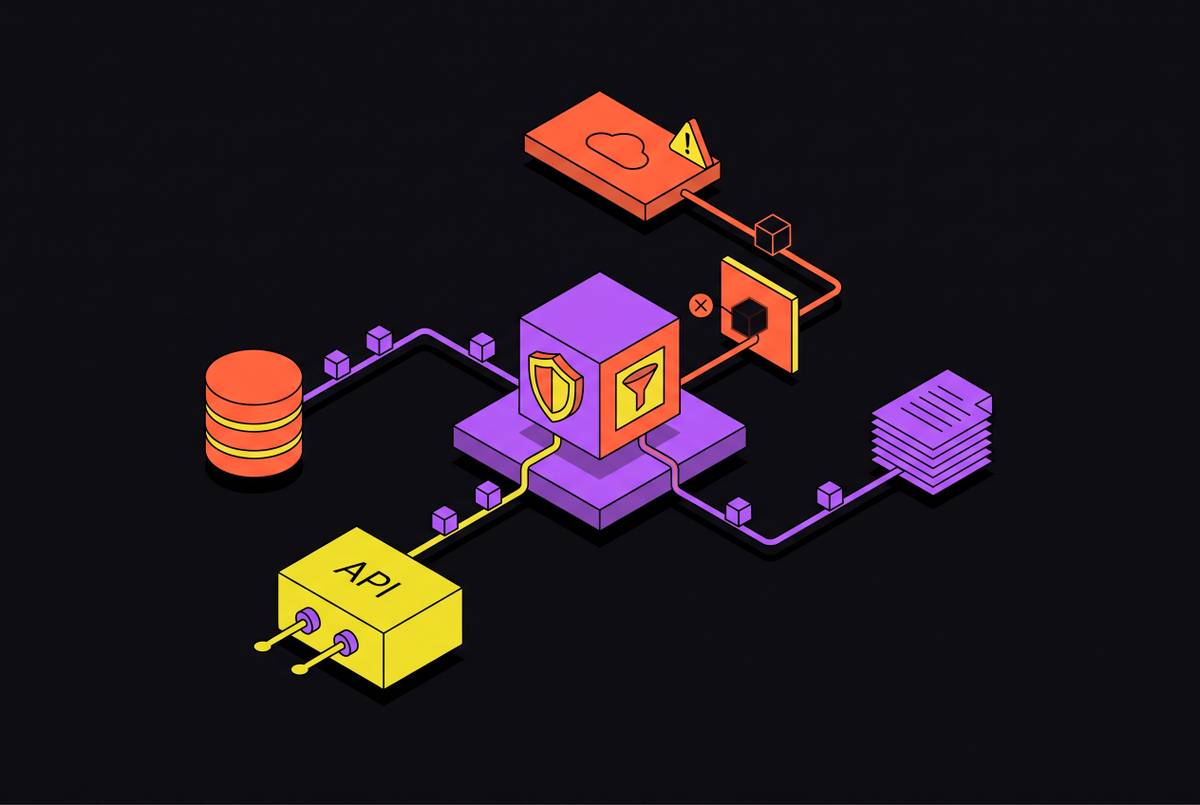
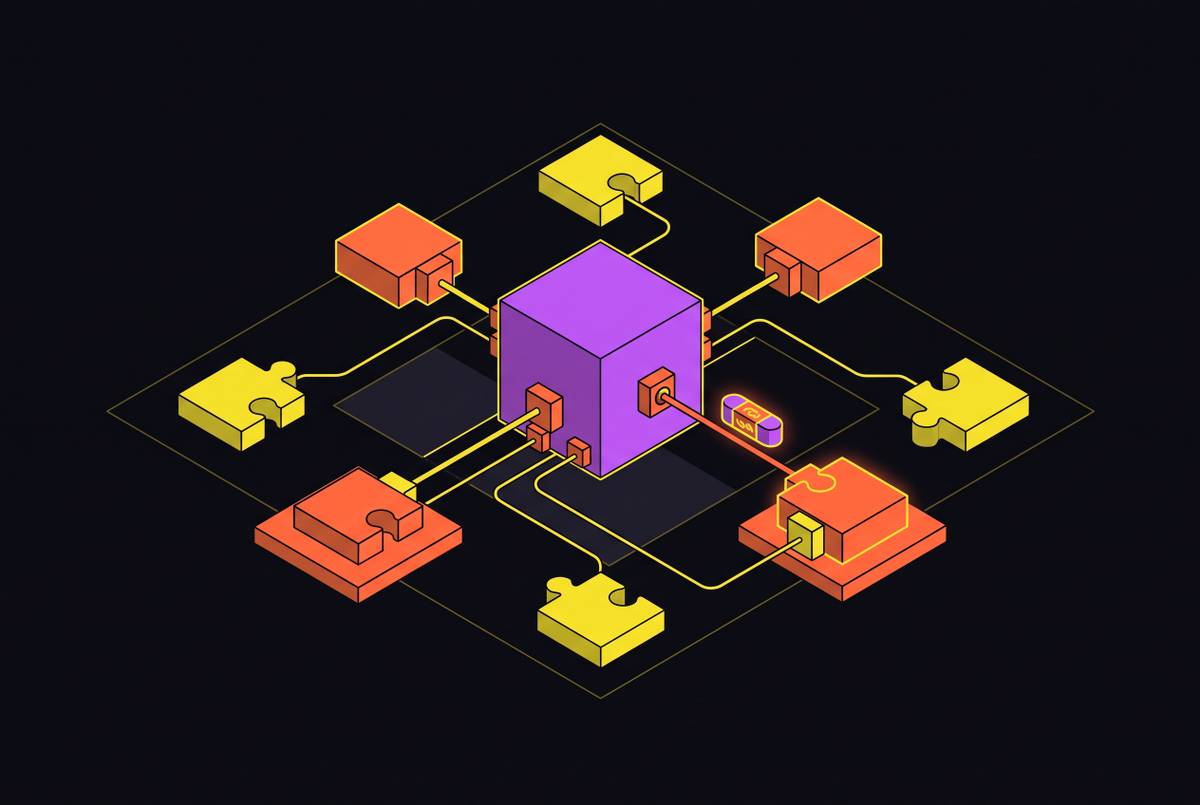
Monitoring RAG Context Windows for Hidden Instructions Before AI Agents Execute Them
Inspecting assembled context before inference catches injections other filters miss.
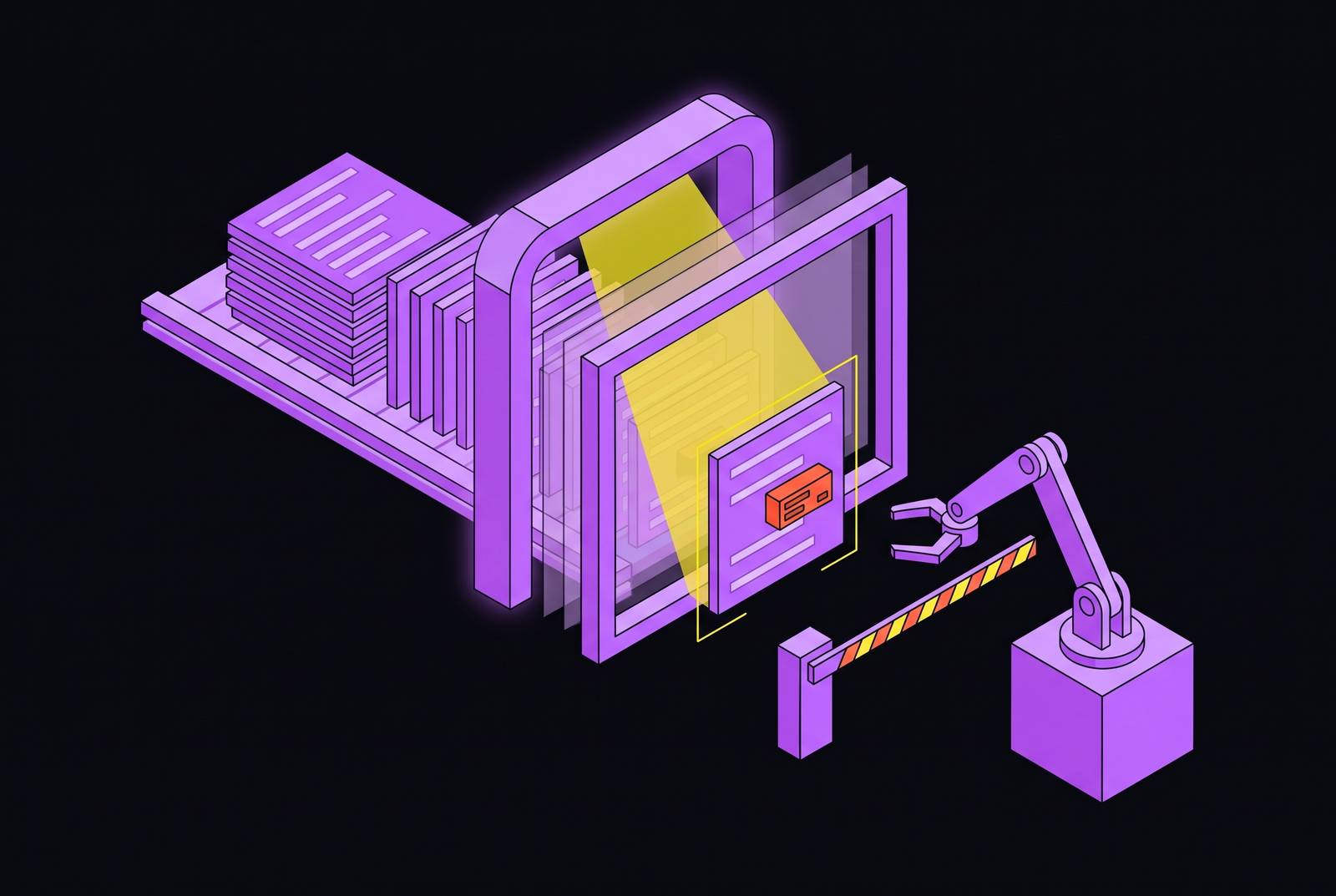
Protecting enterprise RAG pipelines from indirect prompt injection requires inspecting the assembled context between retrieval and inference, then gating tool calls before execution. Hidden instructions come in through reference material, so user-input filtering and document governance cannot take the place of this control. Pre-execution context inspection must identify when retrieved content tries to become an instruction and whether a proposed action follows the user’s intent or an attacker’s directive.
Why LLMs cannot distinguish instructions from data inside their context window
A transformer processes the tokens in its context window through the same attention mechanism, whether they come from a system prompt, a user query, or a retrieved document. Those sources have different levels of trust in the application, but they enter the model as a flat token sequence. Attention has no built-in way to enforce a privilege hierarchy.
The separation between instruction and data depends on model behavior, which can allow retrieved instructions to influence the model. Better prompt engineering and fine-tuning alone cannot change that structure. The model can still follow instructions in external content even when the developer labels it as reference material. Security therefore requires examining what enters the context as well as what the user asks.
How malicious instructions reach the context window through retrieval
Greshake et al. (2023) showed indirect prompt injection at work against Bing Chat, code assistants, and email processing systems. The attacker plants instructions in an external source before the AI system retrieves it. No direct interaction is needed when exploitation occurs. A harmless user request can set off the attack just by making the system fetch the poisoned content. OWASP classifies prompt injection under LLM01 in its Top 10 for LLM Applications, including the danger of instructions entering through data channels.
An email assistant makes this route concrete. In this scenario, the attacker places a directive inside an email that the assistant later retrieves while serving a legitimate request. The directive might sit in a quoted email block outside the visible part a person reads first. Once that block joins the context, the model encounters both the user’s task and the attacker’s instruction. The user has submitted nothing suspicious, so scanning the user’s message does not inspect the attack.
The same route extends beyond email bodies. Knowledge base poisoning introduces malicious documents into a vector index, while document manipulation embeds instructions in otherwise legitimate material. Metadata injection puts directives in titles, author fields, or other fields that become part of the context during context assembly. Footnotes, tables, HTML attributes, markdown links, image alt text, and white-on-white text can also conceal instructions from human reviewers. Chang et al. (2026) show that indirect injection can survive realistic retrieval pipelines, so indexing and retrieval cannot be assumed to strip it out.
What hidden instructions can do once inside an agent's context window
The severity of an injection depends on the agent’s tool access as well as how elaborate the payload looks. A simple directive becomes more dangerous when the agent can reach databases or invoke external tools. The harm need not stop at a misleading answer. Documented attacks have led to instruction override, system prompt leakage, output manipulation, and unauthorized tool use. In healthcare, finance, and legal settings, an agent with database access can turn this weakness into a path to regulated data exfiltration.
The exposure also extends beyond a single interaction. A poisoned document that comes up often in retrieval can affect every user whose query brings that chunk into context. One artifact can therefore produce many victims. Yet the same artifact may remain dormant until a particular retrieval pattern activates it. Monitoring that looks only for suspicious activity between deployment and activation can miss the latent instruction sitting in the corpus.
These properties make the timing of detection decisive. A hidden directive may be harmless while stored, influential when retrieved, and damaging when translated into a tool call. Document controls address the stored artifact, while action controls address what the agent attempts to do with it. Neither removes the need to inspect the assembled context at the point where passive content can become an instruction.
Why defenses applied before or after the context window leave a gap at the moment of execution
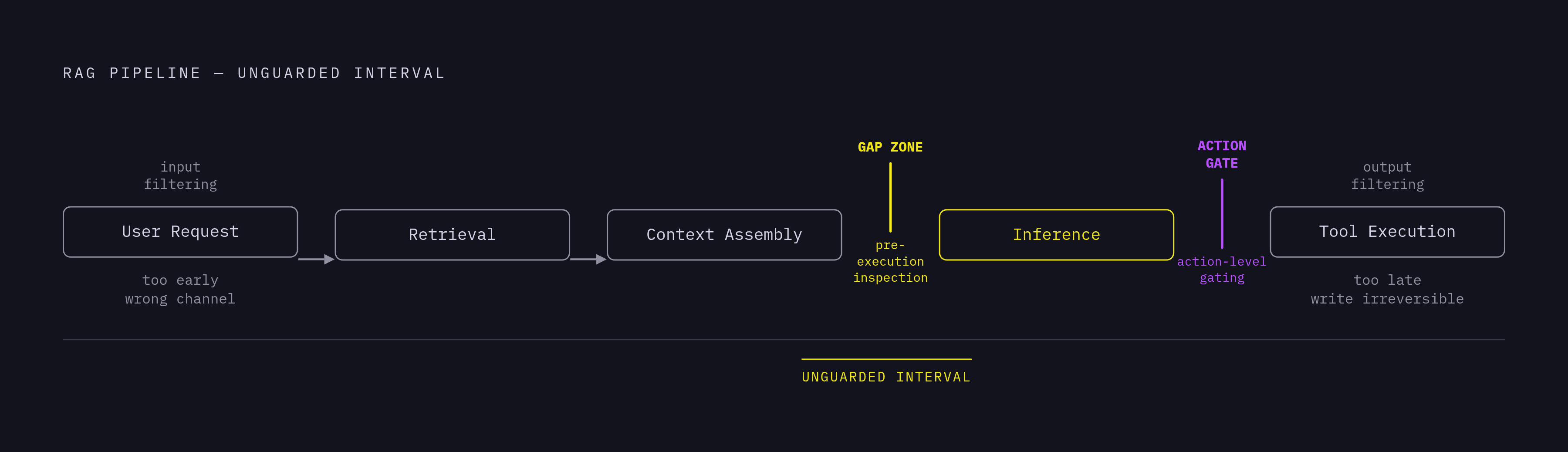
Input filtering inspects the wrong channel for this attack. The user’s request can be entirely legitimate even when the retrieved material carries the malicious directive. Source trust tiers, provenance checks, and retrieval filtering address that external channel, but they cannot guarantee clean context. Legitimate documents can be modified after indexing, and metadata may escape sanitization. A trusted source is not proof that every component assembled from it is safe.
Content scanners face a different limitation. Encoding, language switching, adversarial spelling, and indirect phrasing can preserve meaning for an LLM while defeating syntactic or regex-based checks. A secondary model used as a gatekeeper is not automatically independent protection, either. A document that tells the gatekeeper to output “SAFE” attacks the guard through the same mechanism it is supposed to detect.
Output filtering operates later in the chain. It can catch harmful generated content, but it cannot reverse a database write, an API call, or an email already sent. That distinction is critical for agents with execution rights. A clean final response does not establish that the preceding actions were authorized. Inspection of the answer and validation of the action address different risks.
The gap lies after retrieval completes and before inference begins. At that point, the assembled context exists as a discrete artifact containing system instructions, user input, retrieved chunks, and any included metadata or tool definitions. Earlier checks have inspected only parts of that artifact, while later checks may arrive after action. Pre-execution context inspection checks those parts together before the model acts on what they mean as a whole. Action-level gating then extends protection to the next boundary, before a proposed tool call executes.
What pre-execution context inspection must actually detect
The first detection target is instruction-shaped content in a non-instruction position. Imperative language alone is not enough to establish an attack, but role-reassignment phrases, system-override syntax, and tool-invocation directives inside reference material demand scrutiny. The inspector must model where instructions are permitted to appear and flag attempts by retrieved content to cross that boundary. It must also identify directives that conflict with the system prompt before leaving the model to resolve them.
Metadata needs to be checked as closely as body text. A title or author field can exert the same influence once its tokens enter the context window. The same applies to retrieved image alt text, audio transcripts, and video captions. Al-Lawati & Wang (2026) extend retrieval leakage analysis to multimodal RAG settings, broadening the surfaces that inspection must account for. Checking only the main text leaves other assembled material outside the control.
Towards Secure RAG (2026) categorizes data poisoning, adversarial attacks, and membership inference attacks. SoK: Agentic RAG (2026) discusses prompt injection and data exfiltration in agentic retrieval settings. The detection requirement here is narrower and concrete, namely recognizing when untrusted observations try to redirect behavior, obtain information, or initiate an unauthorized action.
AttriGuard (He et al., USENIX Security 2026) uses parallel counterfactual tests to distinguish tool calls supported by user intent from calls driven by untrusted observations. That shifts the test from whether a passage looks suspicious to whether it caused the proposed action. Such a test complements instruction-pattern and conflict detection. Together, these checks require a structured record of what entered the context and where each component came from.
What a monitoring approach covering the retrieval-to-execution interval looks like in practice
A Context Bill of Materials, or CxBOM, provides that record at assembly time. It captures system instructions, retrieved chunks, user input, and tool definitions, together with provenance, trust tiers, sanitization events, and allowed or denied actions. This makes the inspection process auditable and anomalies investigable. Without a record of the actual assembled context, a later investigation cannot reliably connect a suspicious execution to the material the model received. Logs of retrieval decisions, prompt composition events, and tool calls let investigators trace what happened.
The architecture must also separate reasoning from execution. Parallax proposes an architectural separation that prevents the reasoning system from directly executing actions and a validation process that places an independent, multi-tiered validator between reasoning and execution. The validator must not simply reproduce the reasoning system’s vulnerability. OpenParallax is the open-source reference implementation of the Parallax paradigm, written in Go, and provides a concrete artifact practitioners can examine.
The paradigm’s Information Flow Control principle propagates data sensitivity labels through agent workflows. Those labels preserve distinctions about retrieved content through context assembly so that the validator can use them at execution time. Its Reversible Execution principle saves the state before a destructive action so that rollback is possible when validation fails. Prevention and recovery serve different purposes here. Some actions may pass inspection and still need to be undoable, so monitoring cannot end at an initial approval.
For each proposed tool call, it re-executes the agent with a control-attenuated view of external observations while teacher-forcing the original action history. The comparison gives the observations less power to steer behavior and keeps the earlier sequence of actions the same. It blocks the call if the shadow execution does not reproduce it. The test asks whether external content acting as an instruction drives the action independently of the legitimate task.
These approaches operate at different points in the workflow. The CxBOM records the assembled evidence, independent validation checks the boundary, and action-level gating examines what the agent is about to execute. None substitutes for least-privilege tool access. Limiting which tools the agent can reach limits the harm from an instruction that gets past inspection, while detailed logs help investigators when real-time detection misses it. Monitoring therefore calls for layers built into the architecture as well as a choice of products.
Why continuous vendor AI monitoring cannot stop at deployment
Knowledge bases change, vendor AI components update on their own, and new payloads appear in production data sources. A deployment review captures only one state of that system. Retrieval pipelines need testing with abuse cases whenever the corpus, retriever, or prompt template changes. Each change alters the attack surface. A previous assessment cannot establish how the next assembled context will behave.
Vendor dependencies make this harder to contain internally. LLM APIs, RAG infrastructure providers, agent frameworks, and MCP servers expose enterprises to AI components and retrieval paths they do not fully control. A directive in a vendor-supplied document or connector output can enter through an accepted data flow without a conspicuous perimeter breach. The source may already be approved for use. Approval does not show whether its knowledge base was poisoned between assessments or whether a connector update changed how it handles metadata.
Continuous vendor AI monitoring must therefore cover retrieval sources, assembled context artifacts, tool call logs, and behavioral anomalies that suggest injection-driven execution. Traditional third-party risk management assesses vendor security posture at a point in time, while these signals concern what happens during operation. The two forms of oversight answer different questions [1][2][3][4][5]. For TPRM, InfoSec, Privacy, and Legal teams, dedicated AI risk intelligence connects assessment of vendor AI assets with ongoing monitoring for emerging threats to compliance and business continuity.
Pre-execution context inspection is a security discipline that existing input filters and vendor governance checklists were not built to perform. Enterprises remain most exposed when they treat it as an extension of those controls instead of assigning it separate operational responsibility.
Sources
- Parallax: Why AI Agents That Think Must Never Act
- SoK: Agentic Retrieval-Augmented Generation (RAG): Taxonomy, Architectures, Evaluation, and Research Directions
- Towards Secure Retrieval-Augmented Generation: A Comprehensive Review of Threats, Defenses and Benchmarks
- Indirect Prompt Injection: The Hidden Attack Vector in RAG & Agents (2026)
- RAG Security: Protecting Retrieval-Augmented Generation Systems (2026)
- Document-Authored Control-Signal Impersonation: A Low-Cost Indirect Prompt Attack on RAG Safety Boundaries
- The Illusion of Role Separation: Hidden Shortcuts in LLM Role Learning (and How to Fix Them)
- ATR-2026-00265: Latent Injection in Retrieved Document / RAG Context